02 October 2015

Two podcasts I've chatted on recently

You know how I love podcasts. I wrote about them here and here. I only just noticed one of my small screen (and now podcast) queens tweeted my link out. I love Leigh.

Leigh Sales tweet to Carly findlay


I listen to podcasts every day. I am addicted. I put them on when I'm working on spreadsheets or drifting off for a nap. I listen when I'm skipping. And they teach me so much.

I also love speaking on podcasts - and in the last month or so, I've had the opportunity to speak on two! I've got another interview lined up soon too.

The first is an interview with Gurds Hundal - a London based health journalist who has a podcast called Get Inspired With Gurds. I talk to her about life with Ichthyosis, media portrayal of disabilities and what it was like to grow up looking different. It does get a bit heavy early on, when I discuss not wanting to live when I was young, but mostly it's light hearted. If you need to talk to someone contact LifeLine - 131114 or Kids Helpline on 1800 55 1800 (or the equivalent in your country).

Carly Findlay And Gurds Hundal podcast ad

Listen to that here.

The next is an interview with Pip Lincolne for Kidspot Voices of 2015. It was so much fun - we chatted about writing, going viral, and the importance of using your blog for social good. There was a lot of laughing, of course. Pip is definitely one of my online besties.

Carly findlay and Pip Lincolne

Listen to Pip and I natter here.

Yay for podcasts! It's a public holiday in Melbourne today and I've done some washing, had a nap and watched iView - I'm now going to listen to a.... You guessed it.

Are there any more podcasts you can recommend?


28 September 2015

Quippings at Melbourne Fringe - We don't want pity, we are empowered. We are so proud.

Quippings - Disability Unleashed at Melbourne Fringe

Although it's a workday, I've got wine flu. Our four-show season of Quippings at Melbourne Fringe Festival ended last night. We celebrated with drinks and dancing. My body is sore from twirling a gymnastic ribbon and my throat is gravely from singing Khe Sanh. But I'm on top of the world.

Quippings is a Melbourne based disability performance troupe that I've been a part of for almost three years.

Quippings - Disability Unleashed at Melbourne Fringe

As we toasted the show last night, we talked about what Quippings means to us. All of us said that through it, we've found our tribe. These are our people. People who understand disability issues and aren't afraid to speak about them. We're not afraid to laugh at our disabilities - in a way that takes back our power. We invite the public gaze (literally in our Fringe show - beckoning audience members to look at us, and laughing and pointing at them just as the public has done to us) and we satirise the disability sector. It's such a safe space - body positive and sex positive. This isn't disability like many people assume. We remove negative connotations. We don't want pity, we are empowered. We are so proud.

Quippings - Disability Unleashed at Melbourne Fringe

During the toast, I talked about my first Quippings experience - being in the audience after The Other Film Festival around three years ago. New York actress Christine DeZinno Bruno was performing, and so were some of my Quippings colleagues. I just didn't know I would be involved then. I admitted to being a little shell shocked, my mind was open to butt plugs for the first time. Four months later, I received a message from Kath, butt plug educator asking me to fill in for a performer that night. Shit, I thought. I might have to talk about butt plugs. At a sex bookshop! But I don't know anything about butt plugs! Kath assured me I didn't have to. Phew! So I read out Untouched. It received roaring applause. And then, I guess, I became a performer.

Quippings - Disability Unleashed at Melbourne Fringe

This Melbourne Fringe Festival, our troupe comprised Jax Jacki Brown, Jarrod Marrinon, Kath Duncan, Natalie Corrigan, Ross Cottee, Sonia Marcon, Emma J Hawkins, Daye Han and I. There has been rock and roll, comedy, singing, spoken word, dance, a unicorn doing gymnastics and satirical skits. It's been so much fun. Moving too. I've cried in all four shows. It's been a difficult year for many of us - we're grieving from losing two friends (including Jarrod's partner) in the disability community. Jarrod said Quippings has kept him going. Jax told us last night that she moved from regional NSW to Melbourne because she'd heard about Quippings. Quippings has given my Adam a gift too - he was front of house this year - greeting audience members and setting up lights. His confidence has soared. He feels one of us.

Quippings - Disability Unleashed at Melbourne Fringe

When I talk about disability to some people, they perceive it negatively. It's a bad word. Disability doesn't belong to me. I'm not like those people, they tell me. They're uncomfortable yet earnest about disability - sharing viral posts of disabled people, overcoming. That makes me uncomfortable. We're not there for the public gaze unless we invite it. We don't have to overcome or be a viral sensation to become more 'normal' or make people feel comfortable about disability. But I am like those people - and I am proud of that. And I wish everyone who thinks this way could see a Quippings show and realise disability is not a tragedy.

My part in the Fringe show was reading out an amended version of my letter to my future child. As I read the line "Disability will not be the worst thing to happen to you as my child, or for me as your mother. The worst thing that could happen is other peoples’ closed-mindedness", I thought about how being a part of Quippings has meant that identifying with a disability has not been the worst thing that's happened to me. It's been one of the best things. My closed mindedness has become a little less and I've opened my world to beautiful friends, forward thinkers and the realisation that I'm not alone.

Quippings - Disability Unleashed at Melbourne Fringe

It's been hard work. We've given up about seven weekends and sent countless messages across the troupe, refining our performance. But so worth it. Our professionalism has been top notch - not at all hampered by accessibility issues. There's no such thing as too disabled to perform in Quippings, one performer joked. During our toast, we concurred we're the progressive disability community - there's no one doing what we are. I can't wait to see where it takes us next. I love us.

Thank you to everyone who has come out to see us play. 

Quippings performs regularly at Hares and Hyenas. Follow our Facebook page for our schedule.


24 September 2015

If you're wondering where I am...


I'm taking some time out. Completely overwhelmed, about many things. 

See you soon. Thanks to so many of you for checking in on me. 

21 September 2015

A new start, today.

On Friday I finished up at my day job. I'd been working in that role for eight years, minus about a year and a half when I did two or three other jobs and then returned. I knew it inside out - the processes especially. But in recent months, I felt less connected to the people - not through my own doing, but because of the processes. It became less personal. I felt like I'd progressed so far in all other areas of my life, just not in my day job.

The more things changed around me, the more I realised I need to make my own change. And so I did. My calling is the writing and advocacy, but it doesn't put food on the table, nor pay for weddings and holidays. I still need a day job. I sought change by applying for a new day job. I was successful and I start today.

I'm nervous and excited. Nostalgic. Relieved. My days will be filled with new things to learn, bigger responsibilities, new people to get to know. All still unbloggable.

As my colleagues and I said goodbye on Friday, I felt very loved. I think I did ok in my last organisation. I've got friends everywhere, one of my managers told me. One of my biggest skills is connecting people - and in 12.5 years at that organisation, I'd certainly done that.

The new of today will soon become routine. I'll adjust and come to know the role inside out. And that's ok because I've made my own change. It's time.


17 September 2015

A letter to CEO Susan Wojcicki: on bullying of people with rare medical conditions on YouTube

UPDATE: 3 October - the video has been taken down. Victory! Read about that on the South China Morning Post.

Dear Susan Wojcicki, CEO YouTube.

I am writing to you about cyber bullying on YouTube. You must be so proud of this platform you lead - it is a trove of entertainment and information. But you have reason to be so disappointed by the derogatory, hateful and misrepresenting videos on YouTube.

I have a rare, severe skin condition called Ichthyosis. It's medically challenging, but the social challenges (ridicule, exclusion, comments and stares) are worse. Fortunately the Internet has connected me with some amazing people - I've got friends who are affected by Ichthyosis across the world. It's a wonderful, supportive, resilient community.

On Thursday I was alerted to a video that features two of my friends with Harlequin Ichthyosis, and many other people with visible differences caused by medical conditions. The video was called '15 Terrifying Rare Birth Diseases of all Time'. I was shocked, hurt and and angry. And so very sad for my friends. Please don't watch the video. But do report it.

A YouTube Account called Elite Facts have stolen photos of my friends with ichthyosis and of others. My friends are devastated at the misuse and misappropriation of their photos. It's very upsetting for our community - especially to know that this condition is portrayed as "terrifying".

Elite Facts have ridiculed medical conditions and appearances. They've termed their appearances as 'terrifying', which does nothing to decrease the stigma of living with a visible difference. They are not informing or educating, they are exploiting and bullying. Through allowing comments, they are encouraging hate speech.

I have reported the video and so have many of my friends.

Here are my friends Hunter and Mui at their best.

Mui has been featured on CNN and done a TedTalk about her experience being cyber bullied. She's a rugby referee and she hand her parents are writing a book. Mui blogs here. See that smile?' Gorgeous.

Mui Thomas rugby

And Hunter has chatted to Katie Couric. She's studying abroad right now. She and her father have done great work raising money and awareness for the foundation that supports people with Ichthyosis.

Hunter Steinetz
Hunter Steinetz with Katie Couric

Both women are mentors and role models to children with Ichthyosis - and to me of course. I've not met them in person but I love them. (And I think beautiful smiles are part of the Ichthyosis gene.)

Mui and Hunter are not terrifying. They are smart, driven, positive and beautiful. They deserve dignity and respect. They were hurting so much, impacted by the video and crying at the comments. Look at them together as children.

Hunter tells me, "I am hurt and disgusted that someone would use my image and talk about my condition in a manner that only belittles, not educates. Elite Facts does not portray anyone in that video as a person. They treat those conditions as if it's a joke. I want them to understand that we are real people and we carry on our daily lives."

And Mui says: "I am of course devastated at what I woke up to as no one should have to deal with that. I felt that Elite Facts were incredibly blaise about their choice of material and words. What they did, hurt not just me, but so many others. It's one thing to raise awareness of visible difference. But this was certainly not the way to go about doing so."

They both use the Internet to advocate and educate on their own terms. Their experiences should garner more attention than shock factor videos such as Elite Facts (who reveal with their own actions, are not elite nor factual). The condition is hard enough without content like this being created and spread.

Susan, I ask you, as YouTube CEO, to ensure YouTube is a safe place place for people who look different. I ask you to take action against these bullies - the video creators and commenters. They are hurting real people - and in this case, spreading misinformation that scares the masses.

And I ask you as a mother to protect the vulnerable. To ensure that people like Hunter and Mui, and countless others who look different for whatever reason, don't have to fear stumbling across ridicule and hate speech like this on the Internet.

Thank you - I appreciate you ensuring videos like this aren't created, shared, commented on and perpetuated. We are not freak shows.

Carly Findlay

If you're being cyber bullied, you can get help at ESafety. This is an Australian government website - there will be equivalent websites in your countries.

You can report abusive YouTube content here.

Let Susan Wojcicki know what you think about bullying on YouTube by tweeting her.

EDIT: Mui's parents have started a petition to end shock videos on YouTube. Sign that here.


Lady faves.

This post was written for I Support the Sisterhood - Jordy Lucas' project. It's a website showcasing the talents of women doing great things - artists, entrepreneurs, social good makers... They shine! Jordy used to be on Neighbours, playing Summer. Check out her Instagram too.

Some writers I've met in real life: Kerri Sackville, Pip Lincolne, Clem Ford, Jax Brown, Em Hawker, Fashion Hayley, Nicole Rouge


It can be a little lonely being an online writer. That seems like a contradiction, right? I mean, we are connected to others all the time online – through social media, blogs, skype and email. I’ve formed so many friendships and even professional networks – and because blogging is mostly done by females, But the act of writing and connecting is done alone – for me it’s on my couch or even in bed, snug in my pyjamas and sometimes with a wine beside me. I write in the evenings and on weekends. I have a day job too, so I’m surrounded by people all day. But those who don’t write don’t often understand the loneliness and also the friendships formed from being an online writer.

Writing as solo pursuit – and of course writing my life - means I’m inside my head a lot. I think and dream and write constantly – my electronic and paper notebooks are filled with ideas and paragraphs and half-finished blog posts. I write about what it’s like to look different and hope add a more diverse face and voice into the media. I’ve been blogging for a long time – on and off since 2001 – my current blog is almost six years old. Through writing my life, I’ve come to know me, and also wider issues. In a podcast interview, Tavi Gevinson said something that resonated with me deeply: "In writing about my own life, I come to new ideas that are larger than myself." It’s been that case for me too – I’ve come to identify with and learn about disability issues, and immerse myself in that community. And it’s wonderful.

Most of my friends are inside the computer. On the internet. I’m not antisocial or withdrawn. In fact, I’m more social than ever – chatting away with the TV on in the background, or sending texts to besties through the day. And increasingly, my friends are crawling out from the computer, appearing in 3D at events and meet ups – and I relish those social occasions. The energy in that room is incredible.

I recently went to Problogger conference where more than 700 bloggers came together to learn and to socialise. Of these, less than 70 attendees were men. It was a fantastic chance to catch up with old friends and make new friends, and discuss blogging with people who truly get it. They know how hard it is to just turn off the computer when a bad comment comes through, and why I maximise my walk to work by scheduling social media posts for the day. They understand the need to jot ideas down as soon as they come, and are totally fine with a table of friends photographing and then Instagramming dinner (a really good friend shines light over a plate of food when the restaurant lighting is bad!). They also love the rush of crafting a great blog post or article.

At Problogger, there was talk of having an accountability partner. That is, a person you can tell your goals to, and have them keep you on track. They’ll check in to see how you’re progressing, give you a prod when you need it, and offer you a hug, a wine and lots of reassurance when you’re feeling like a failure. They’ll also celebrate your milestones. Because they believe in you. And you’ll do the same for them. I was thinking of who my accountability partner is. And I have a few.

I have a number of friends who I bounce ideas off. We all write about the same sorts of issues – disability, chronic illness and appearance diversity – and the politics and pride surrounding them. We are all really feisty, independent women wanting positive change for people on the fringes. It can be hard to discuss seemingly progressive ideas with others outside of the disability pride movement – and so it’s great to be able to have robust and supportive discussions with these friends. I call on one or two of these friends to proof read my articles before sending them off to my editors. And We are big sharers of each other’s work too. That’s super important.

I also have a really wise, caring friend who’s been a blogger for almost 10 years. She really knows blogology, and is a leader in forging her own path rather than following the masses, which I love. She’s not worried about page views or the latest trend. She cares about community and nurtures her own community beautifully. My friend encourages everyone to be their best, to live a creative life and just do things for the love of it. And she’s got my back.

A little while ago, I had an awful experience after I wrote an article. Of course writers put their opinions out there to be critiqued. But the delivery of the critique can hurt. A lot. And so when I was really hurting, she was there for me, checking in to see if I was ok, sharing and seeking lots of diverse opinions about the issue I wrote about over on her social media account, and reassuring me that I was still a good person despite a few people thinking (and saying) I wasn’t. Thanks to her, I felt so loved, and really cushioned during a not so nice time. Every blogger needs someone like my friend in their life.

It’s so important we show other writers we admire them by telling how great they are and by sharing their work. I always share things that are interesting and I really enjoy reading, and I do hope to boost the writer’s profile by sharing on my social media channels. Here are some blogs I love:

Pip Lincolne - reading Pip’s blog is like having a cup of tea with a friend. Pip also termed Lady Faves, and I've borrowed it for this post today!

Colour Me Anna – beautiful Anna writes about anxiety – I just love the way she uses colours as metaphors

Living with Bob – Michelle writes about living with a chronic illness, Dysautonomia.

Bruises You Can Touch – Carly-Jay writes dreamy verse, death midwifery and observations about life after a lung transplant

Frocks and Frou Frou – I LOVE Lilli’s wardrobe – especially the way she alters clothing to give them a personal touch.

View my original post on Jordy's website.

Listen to a podcast I did with Pip!


14 September 2015

What to consider when the media asks you for your story (about life with ichthyosis or facial differences or disabilities).

I receive emails from journalists and media makers asking me to tell my story about life with ichthyosis about once a month now. Most of these are for tabloid media, but some are for public media and well respected publications and programs. I've said yes to a few and no to more. My friends with ichthyosis and other facial differences and disabilities also receive media requests - some have taken opportunities up and that's great for them!

I've sold my story to two tabloid publications. I regret one of them because I had no control. It was sensationalist, they spelt my dad's name wrong and they hounded me doe the story. The other was far more respectful - letting me write a follow up article in third person, even. And I was paid well. I've been on radio many times, a couple of commercial TV programs and on many websites - and for the most part, I've had positive experiences.

I also write for a number of mainstream media publications - some of which could be classed as tabloid. But writing myself is different to being written about.

I blog to ensure I have control over the way my story is portrayed and how Ichthyosis is represented. This has led to me writing for mainstream media publications and speaking on radio and TV and some podcasts.

It's also led to me developing thick skin. Had it not been for my already developed online profile, I'd never give my story to anyone if I didn't have this resilience. I also have the benefit of a media degree and keen interest and a little knowledge of how the media works to help me make a decision. I have media contacts and prefer to pitch my story myself. As I've written previously, I prefer to write for publications that I read and respect, but sometimes I'll tell my story to those I don't, to help influence a new audience.

Tabloid journalists can be pushy. They can lurk in support groups, reading private discussions and then they pounce - assuring you your story is in good hands and will help others. They can prey on people at their most vulnerable, drawing out private details and photos through sneakily winning trust. (I'm cynical!)

Rare medical conditions such as Ichthyosis are not always portrayed in a positive way. Sensationalist, voyeuristic and othering language is used. Cameras zoom in on symptoms, dehumanising the subjects of the story,

Subjects of articles and programs are often portrayed as a victim or hero. Commenters can be brutal. (And even when you write your own story, there's a risk of the sub-editors sensationalising a headline.)

I shared Sarah's story in February. She wrote it for me. Sarah lost her eye as a result of domestic violence. I took great care in publishing it, Waiting six months after receiving it - she was safe from her ex husband then. I provided a trigger warning and links to support services. And an international tabloid wanted that story too. They asked me for her details and when I didn't pass them on, they tracked her down on Facebook. They pushed her when she was at her most vulnerable, convincing her to send graphic photos that she can no longer bear to look at. They didn't put a content warning nor link to support groups. She didn't know or read the publication when she was approached, and tells me she'd never read it now. She regrets it and wishes she'd listened to my advice.

Two friends - one with a facial difference and one with Ichthyosis - told me they sold their stories to media and regret it.

Jackie said:

"I [told my story to the media] and regretted it. Terrible article, made up scenarios and when I explicitly told them I didn't want it published after having a read through they said it was tough and was too late to pull it. I was distraught and there was nothing I could do. I was annoyed at myself too as I'm not naive when it comes to media, but at the same time wanted to set a positive example... can't win!"

Rebekah told me:

"I sold my story to a magazine here in NZ. I wish I had the opportunity to proof read it first ... they didn't really portray me the way I wanted them to. [I was portrayed] like I wanted everyone to feel sorry for me. I wanted to be portrayed more as someone who is out in society making a worthwhile contribution and making most of every opportunity".

But telling your story to the media might be a really positive, empowering thing too! A friend with quadriplegia told me that when a newspaper covered her story, she felt listened to because the journalists were genuinely interested. Your story might help many others, and it can open up some amazing opportunities like further media appearances and getting in touch with others who have your condition. A close friend got a cookbook deal after appearing on a tabloid news program. And the media outlet might be really awesome - I loved working on No Limits - as they allowed people with disabilities to be in control of our stories.

Last week a good friend contacted me for some media advice. A production company seems to be scouring the whole internet for people with Ichthyosis, wanting to make a film about patients with rare conditions meeting for the first time. I say scouring because two other friends have asked me if I know anything about this company. I don't know much, but I've also received three emails from them, asking for my involvement. I've turned them down. It seems they're preying on people with the condition.

I gave my friend the following advice:

It pays to do some research before saying yes. Here are some questions to ask yourself and the media representative.

  • Would you or do you already watch the show or read the publication?
  • What else has the film company or publication made?
  • How sensationalist is the publication or the program?
  • Will the title of the show be derogatory? (Think Embarrassing Bodies or The Biggest Loser.) What about the title of the article? (The Pick Me Up magazine article screamed I ALWAYS LOOK SUBNURNT!)
  • What is the reach? Is it going to mainstream TV? A large publication? Is it tiny?
  • Do you get paid? (You should!) Is it enough compensation to cover the instance that you'll be misrepresented?
  • Can you tell your story to other publications or programs, or are you limited by an exclusivity clause?
  • How much control will you have ever the story and filming and editing? Will they let you see the final draft and allow you to suggest edits?
  • What language do they use? Is it disability positive? Do they use person-first language ("person with disability")? Do they use language that portrays disabilities as tragedies ("suffers from", "wheelchair bound")?
  • Will the story be pitying? Will you be the hero of the story? (neither are good).
  • Will it be inspiration porn?
  • Can you handle the attention of being in the media - good and bad? Is there someone to support you?
  • How will this benefit you? How will this benefit others?
  • Will they represent you well - alter or edit quotes or even photoshop your image?
  • Have you got permission to tell your child's story, if that's what the media has asked for? What will be the long term ramifications?
  • Could you tell your story somewhere else - to a more reputable publication?
  • Could you tell your story yourself? (Maybe start a blog or start a YouTube channel!)

It's ok to say no, and it's ok to say yes, but only if you're 100 percent comfortable with it. I'd be very careful about how Ichthyosis is portrayed. It can be so exciting to be approached by the media, but regretful if it goes wrong.

Further reading

A Guide to Reporting on Disability - People with Disability Australia

Face equality in the media - Changing Faces

Advice on disability language - Arts Access Australia

Have you told your story to the media? Was it positive or negative? What advice would you give?

Did you like this post? Please consider buying me a drink!


11 September 2015

Rest in peace Megan Barron.


(Picture via I refuse EB)


I am devastated. It makes me so sad and angry that skin conditions can be fatal.

I woke up to read my online friend Megan Barron has died. Megan had Epidermolysis Bullosa (EB) - an extremely severe skin condition.

Megan was talented - she interned in the disabilities department of the White House, and wrote for policy websites. She was so smart and funny - and we always made light of our shared experience of rude encounters with strangers, something we had in common. Megan wrote a lot about life with EB, asserting her (our) right for respect.

We'd never met in person but I felt we shared a closeness, discussing difficulties of being an adult with a rare condition when so many others speak for us. Scrolling back through our messages this morning reminded me how much she's done to shape attitudes about skin conditions (both externally and in skin condition communities). I'd often message her to seek her opinion - I valued it so much. She really *got* disability politics and pride, questioning the way skin conditions are perceived, and reiterating she did not need saving. She was one of the few who share my strong opinion that questions about our appearance are intrusive.

Here's an excerpt from my favourite piece of her writing.

"Though Individually uncomfortable and at times, even amusing, these incidents collectively have left scars on me as real as the ones on my body. Rather than heal me as they intended (and you know the old maxim about good intentions), they helped break my self-esteem. They brought forth questions I’ve sought to stifle, questions that repeat in my head with sadistic rhythm when I’m out in public. Do I really seem that broken to people when I walk out the door? Does my body project a fate seem so grim that I actually need saving? Every once in a while I have to actively remind myself that what happened to me was an objective case of a genetic splicing error-not the Devil’s handiwork."

Do take the time to read her blog. She was such a good writer. So intelligent.

Rest gently, Megan. You are so missed. You are far too young to leave this earth.

I hope everyone who knew Megan is doing ok. Sending my love to her family and friends.

In the past nine months, three feisty, beautiful, intelligent, world changing young women I've known and loved have passed away. It's not fair. Life is so precious.


10 September 2015

A guest post from a parent who raises awareness of her child's medical condition.

When I wrote the article (and then blog post) about parents oversharing about their children's disabilities online, I wasn't sure what reaction I was going to get. For the most part, the response has been positive. So many parents have thanked me for writing it. Adults with disabilities have told me about when their photos, stories and illnesses were overshared in their youth. Amd some parents have told me they're changing how they share information online. There have been some harsh reactions too - clearly the post touched a nerve. And parents continue to overshare - the latest was a photo of a child's genitals in a "private" illness Facebook group. I was so angry. Since when is the need for medical treatment an excuse to strip someone of the child's dignity and privacy? Would that parent like their vagina shared on Facebook too?

A couple of bloggers wrote responses to my blog post. Meriah wrote

"We parents need to find a way to share our own stories as parents, and connect with one another while still giving our children the space and wherewithal to tell their own stories the way that they will."

And Alison, who was originally angered by my post wrote:

"But when the initial annoyance wore off, I realised that she had a point.

And it was not her post, but the way she made me feel that pissed me off.

I felt a bit dirty - embarrassed and ashamed.

Like I had made a mistake.

That none of my reasons for writing were about Gabe - but all about me.

Because she is right. Although Gabe can't speak for himself right now (and might never be able to) his story is his and his alone.

Do I have the right to share it for him?

So after a month of not knowing what to write so writing nothing, I am grateful to Carly for making me think more about the child in this blog. About his dignity. The digital identity that I have made for him. I am grateful to her for making me question the reasons behind this blog."

Responses from these parents mean the world to me. They've reassured me my opinion is still valid, despite my lack of motherhood status. Thank you Meriah's and Alison.

Another parent who's resonated with my blog post is (another) Carly, who offered a guest post for my blog. Carly is a pschologist and a mum to a little girl with a genetic condition. She told me she enjoys my writing - finding it humourous and refreshing, and will show her students my blog. She teaches the social construction of disability. Here's her response to my blog. I really like how she covers the challenges of telling our stories to tabloid media.


"When she was five months old my little girl (Ellie, now five) was diagnosed with a genetic condition, called neurofibromatosis type 1(NF). Having no experience of genetic conditions and never having heard of neurofibromatosis I asked the consultant when she would be better. The consultant looked at me somewhat confused and then said as gently as she could "she won't be better it's not cureable and its progressive".

I left the hospital that day somewhat overwhealmed by the notion that in order to come to terms with her condition I would first have to understand it. It felt somewhat like rubbing salt in the wound that my baby had been diagnosed with something I couldn’t even pronounced and that I would have to dedicate many hours of study to before I could begin to understand the implications for her future. Amidst my shock and confusion I was comforted by the knowledge that my career as a Health Psychologist would allow me to dedicate my research time to this condition and that I would be able to share any knowledge I gained with others. I left that first consultation promising myself and Ellie that I would commit to raising awareness of NF and to provide support to the NF community.

One of the first tasks I did was to write an article for a British magazine called 'Pick me up' when the article came out I was proud and excited, I felt that I was one step closer to making NF a house hold name, and although I was only paid a modest fee I was happy depositing it in Ellie’s bank account for her future. In the first couple of years since Ellie’s diagnosis I had a few stories written in local papers and even a national at one point, I was praised within the NF community for raising awareness and I truly believed I was. Then one day I taught a class to my students on representations of genetic conditions in print media (I am a lecturer in Psychology at Manchester Metropolitan University) I asked them to read various stories of genetic conditions, and tell me their thoughts but something unexpected happened; the students described the parents as self-serving; trying to evoke sympathy; they questioned the ethics of those parents who had sold their stories without considering what they may have used the money for and worst of all not one student remembered the name of any of the conditions! After being initially defensive I realised that lesson was something of a eureka moment telling Ellie’s story wasn’t raising awareness of NF because the final version of the story was written by the journalist with a different goal in mind.

Recently another mother with the NF community told her story to a national news paper and the headline was so sensationalist that she received a heartbreaking amount of bullying from people telling her she was selfish to have had children. This lady did not in fact "sell" her story she gave it freely, she thought she was doing a favour for a charity by raising awareness to help others. Ultimately it didn’t raise awareness of NF as the information pertaining to NF was inaccurate implying that it is terminal whereas it is actually extremely variable and unpredictable. This poor woman brought unnecessary negative attention towards her family and quite frankly the journalist should be ashamed.

Which brings me to Carly's blog post on "parent bloggers" and how much information we should share about our children, even when the words are our own. This is a topic to which I have given a great deal of thought and have come to the conclusion that my views on this are pretty much the same as my views on parenting as a whole, and you need to ask yourself 1) how does it affect your children now?, 2) how does it potentially affect your children in the future?, and 3) how does it benefit others?. I have read and re read Carly’s blog and I genuinely can’t understand why it was viewed as controversial, personally I think the blog presents an extremely balance view and rather than saying parents shouldn't blog about their children. Carly is simply asking parent bloggers to give consideration to what they say, how they say it and how the reader may interpret it. The latter is the hardest to do of course as we become so immersed in our own narratives that we cannot see alternative views.

Since my ‘genetic conditions’ seminar I have been much more mindful in my awareness raising and have refused many things because I didn't agree with the angle or over concerns of the potential aftermath and whilst I still do press and blogging I give full consideration to every word written and every picture shared. For sharing more specific details to benefit others I still do this within a closed FB group for people affected by NF, in this way there is a direct benefit from our shared experiences. But there are some details I have not. I will not share - they are Ellie’s story not mine, and if she decides to share them in the future that is her choice. I can't deny that I have personally benefitted from blogs where people share much more; have felt less alone when reading about similar experiences and ultimately realised my daughter is disabled though the way those blogs reasonated with me, and for that I am grateful. Thinking of one blog in particular describing two autistic children and judging it by my own criteria, I don’t think this blogger is oversharing. In fact exactly as Carly points to in her blog post I am sure every detail is considered and reconsidered and that many more personal and intimate details are omitted compared to those that are put in.

In closing I would like to say how grateful I am to Carly for inviting me to write this piece and if anyone would like to learn any more about NF1 please visit The Childrens Tumour Foundation."

Would you like to write a guest post for my blog? The guidelines are here.


07 September 2015

On othering. Dismissing people as being less human than we are.

This past week, the world was talking after seeing the image of a little Syrian boy washed up on the shore. Heartbreaking. Three year old Aylan Kurdi, his five year old brother Galip and his mother Rehanna drowned in the sea between Syria and Greece. The family was desperate to make a safe life, so they fled from war-torn Syria. "You have to understand, nobody puts their children in a boat unless the water is safer than the land."

Sydney Morning Herald reports Abdullah Kurdi told the Turkish news he hopes that his family's story, his little boy's picture that is so hard to look at yet went viral, will make the world see the humanitarian crisis.

"The things that happened to us here, in the country where we took refuge to escape war in our homeland, we want the whole world to see this," he said.

"We want the world's attention on us, so they can prevent the same from happening to others. Let this be the last."

BBC World News says the Kurdi family made three prior attempts to escape Syria - paying money to people smugglers to get them to Canada to stay with relatives. The fourth attempt was fatal. (Kurdi has been a surname given to the family by the media - and Aylan is the Syrian interpretation of Alan.)

"Alan set out before dawn that morning in Turkey for the Greek island of Kos with his father Abdullah, mother Rehanna, and five-year-old brother Ghalib. The Kurdis wanted to reach Canada to reunite with Abdullah's sister Tima, a hairdresser in Vancouver.

The family joined with a small group of refugees in Bodrum to attempt the 4km (2.5 mile) crossing to Kos. Abdullah texted his sister Tima from the beach to say they were leaving. "I passed the message to my dad in Syria," she said, "Abdullah is leaving now, pray for his safety."

But her prayers went unanswered. The two small boats were hit by high waves minutes after they set off and the captain fled. Abdullah Kurdi found himself fighting to save his two young boys. Of the 23 people in the group, 14 are believed to have died, including Abdullah's wife and sons."

Mainstream and social media has reacted strongly to this story, particularly the photo of Aylan. Many believe his photo should not have been shown, but there are also arguments that this photo will change the way we think about and work to make refugees safe. Tara Moss has written a great piece on the ethics of sharing photos of the deceased.

I watched the story being covered on The Project - they chose not to show the photo (although that link does show it - graphic image warning). Host Carrie Bickmore broke down, and Chrissie Swan said something very profound - perhaps as game-changing as Aylan's photo.

When Chrissie said "It's very easy when you're using words like refugee and asylum seeker and 'othering' words,", I applauded. Not because of the actions she's describing but for raising the issue of othering on national TV.

So many times privileged people sit back, apathetic, prejudiced and judgmental, saying 'those people aren't like me". But refugees, the disabled, indigenous, Muslims, black people, the LGBTI community - they're all people. They're just like us. They are us. Little Aylan is someone's son - someone who loved him enough to put him on a paper boat to give him a better life.

The most vulnerable in the world need our help and compassion, not othering.

I posted the above passage on Daily Life's Facebook page and then on my own. People empathised and wept. Later I read the most racist, narrow minded, violent comment from someone I know. I deleted it immediately. I am revolted to know someone who has these feelings. It was othering at its worst, denying that refugees are human, that they love and they're looking for a safer life. This 'friend' is no longer.

I've othered in the past - perhaps due to media and friendship influences, and a lack of knowledge. For that I am so sorry.

James Norriss, from There Are No Others blog explains the concept of Othering:

"By "othering", we mean any action by which an individual or group becomes mentally classified in somebody’s mind as "not one of us". Rather than always remembering that every person is a complex bundle of emotions, ideas, motivations, reflexes, priorities, and many other subtle aspects, it’s sometimes easier to dismiss them as being in some way less human, and less worthy of respect and dignity, than we are."

Othering is not talked about much in the mainstream media. It is more so talked about by those who experience and are impacted by othering language. So, it's very important presenters on prime-time current news shows address the issue.

Othering is when I've been told I'm not disabled because disability has negative connotations.

It's when they've said my mum's not black like other black people (and so it's ok to make racial slurs).

It's when someone wishes I'd have told them about my friend's disability before they met her.

Othering is a former friend writing "I've got many gay friends but I wish they didn't live this sinful lifestyle".

It's watching the news with apathy, dismissing people killed at sea as "just migrants".

Othering is when someone tells me "I love taboo and politicallly uncorrect words. At work I used to get in big trouble for referring to people with a disability as retards. But I can get away with calling my colleagues retards. Why is retard such a taboo word?"

It's newspaper headlines and politicians calling certain religions "death cults".

It's when a parent begs for acceptance for their visibly different child but blatantly states they will not accept gay people in the community.

Othering is when a stranger tells me I'm really attractive, despite my face looking like it's burnt.

Othering is when a waitress tells me my friend in a wheelchair "will have to sit at a different table so they don't get in the way", and then being incredibly nice to them when she sees how good looking my friend is.

The impact of being othered is a refugee lying about being a student in Australia, and visiting his parents in Sydney, because "the words asylum seeker and refugees are very bad words in Australia". He tells little white lies to make others feel more comfortable.

Othering is divisive. It's biting. It's dehumanising. It needs to stop.

Further reading

How we can help refugees

Talking Frankly's amazing piece on how she feels about the refugee crisis

To the mother of Aylan - a letter by Rebecca Bowyer

How artists have responsed to the tragedy of Aylan and others killed at sea (graphic - yet beautiful - image warning)

A Chrome plugin that changes "illegal immigrant" and other dehumanising terms to "human"

Spread the word to end the word has great resources about why the R word is unacceptable.

Tamzen Temple wrote about othering too.

A beautiful welcome for refugees

06 September 2015

Wedding planning.

It's just over six months until our wedding! Six months. I cannot believe how fast the time has gone. When I think forward to our big day, I'm excited that we've got so many of our friends involved in making it special.

Right now I've kicked into planning mode. I'm so glad that I've done a lot of the big ticket items already (savings account, venue, dress, shoes, suit, cake, photographer, celebrant, DJ, MC, florist), and now we're just focusing on the smaller details. I feel lucky to be an event planner in my day job, because I feel seriously organised. I'm hoping to have the whole thing done by December. Is that too crazy?!

As I wandered through a wedding dress store yesterday, I thought about how it was 15 months ago since I bought my dress. I'm really glad I bought it then, because walking through those stores just did not inspire me. The wedding is becoming more DIY as my eyes glaze over at how wedding paraphanelia is both too boring and blingy for my taste. I want unique and colourful and fun. I also don't want to buy anything that I won't wear or use after the wedding day (I might even wear my dress again!). Lucky Camille is one of my bridesmaids and she's ready to get crafty. Paper invitations, a bag, bouquet and jewellery are on my to-do list for the next month. And a big trawl through Etsy of course.

I'd love some advice on good hairdressers in Melbourne. Let me know your tips.

Also, I've been wondering how I can get you, my blog readers involved in the day? You've been so lovely and supportive, so I'd love to 'have you there' to celebrate with me. Have you got any ideas?

Tell me your best wedding tip!


31 August 2015

I sold my blog for a bar of chocolate. Blogging and monetisation.

Bar of chocolate. Text: I sold my blog for a bar of chocolate.

Five years ago I sold my blog for a bar of chocolate.

I don't enjoy cheap chocolate. Yet I gave up space on my blog to advertise cheap chocolate for $110. I'd sold myself short. As I've furthered myself as a blogger, I regret it.

When I was approached by Nuffnang to write about chocolate for payment, I thought I'd made it as a blogger. Instead it left me empty. I had to include scripted-wording in my post. I don't really like chocolate so I wasn't a convincing salesperson. Anonymous (it's ALWAYS anonymous!) commented: "sellout. I do normally love your posts though." Back then, my metaphorical skin was really thin, so I might have cried! And a reader received $50 worth of chocolate - not the greatest prize in the world!

Back then, new to the commercialised blogging world but not new to blogging, I wanted to work with brands. Everyone was doing it. I wanted to have that type of success and exposure they were having. I wanted to be a part of the in-crowd and make some money. I tried seeking advertising spots - nadda.

No brand wanted to work with a chronic illness blogger. I wasn't pretty enough or cool enough or commercial enough. And I'm not saying that to fish for compliments - but a brand does want a certain look to sell a product. But not even Vaseline wanted to sponsor me - and hell, their product keeps me alive. Back then, that rejection hurt.

I kept blogging - focusing on my writing, and slowly getting published elsewhere. Being published on a national (or international) website is a far more satisfying than being paid to write a sponsored post. The readership is loyal and vast, and I can explore interesting and important issues. And it's a way to make a little play money. I've won some awards and brought a community of people with my skin condition together

Working with brands is not my pinnacle of success. It might be yours, and that's completely ok. But I'd never want to let working with brands stand in the way of my writing and storytelling. I'd rather make money away from my blog.

My blog is primarily about writing. I don't want to inundate my blog with sponsored and gifted posts. But I would love to occasionally be rewarded (and compensated) for my time, knowledge and influence. I do the occasional sponsored post (like, two a year!) and have worked to promote a few brands that align with my values. I've been flown to Canberra for the amazing Human Brochure tour, and test drove a car and was paid to write a sponsored post for Ford as a part of the Kidspot Voices alumni.

I've got a relationship with St Frock - they give me lovely clothes and I post photos of me wearing them. I do this because I love fashion and I also want to ensure there's appearance diversity in fashion. I love the St Frock success story, and was friends with its founder Sandradee before our professional relationship.

I also recently pitched myself to Olympus, just before the Australian Ichthyosis Meet. I wanted to promote positive body image and appearance diversity on social media, and I wanted participants at the meet to feel good about themselves when they see themselves in photos. So I wrote to Olympus and told them my vision. They gave me an awesome camera and also one to give away to a participant at the meet. The winner was a little boy with Ichthyosis. He loves the camera! And I also sourced a heap of goodies to give away to guests at the Australian Ichthyosis meet- many brands supported the meet. As I said in an interview I did for Problogger, I leveraged with brands for social good.

When I was at Problogger, I listened to Heather Armstrong (Dooce) and Kayte Murphy (Mrs Woog) discuss personal blogging and monetisation. Their opinions differed greatly - and perhaps that is because of the current state of the Australian blogging scene compared to the maturity of the American scene. I expect for bloggers who are starting out with the view to make money, or even just to have their writing noticed, their discussion would have been a little depressing to hear.

Heather Armstrong, Lauren Dubois and Kayte Murphy discuss personal blogging at Problogger

Both women started blogs for personal reasons, and after blogging for a few years, they realised they could monetise. Kayte loves writing sponsored posts (which are, surprisingly, hard to come by), finding them a good challenge. (And I think she does them well, incorporating a story into them and not sounding artificial.) They both believe the future of storytelling is via mobile and YouTube.

Heather and Kayte both spoke about the importance of getting paid for advertised content. "Free isn't going to pay the electricity bills", Heather said. Not being paid "makes it hard for all bloggers to make money", she continued. Kayte believes it's important for bloggers to make their own choices in deciding to work for free or not: "I think you're all big people and can decide for yourselves about what to do".

In recent years, Heather didn't want to put her children's faces on her sponsored posts. And that was one reason she gave up blogging. She also felt burnt out because she cannot celebrate content creation to anyone as a personal blogger. "I can't sell anyone but me."

"My earning potential is not a component of my happiness...a blog post is my heart and I had to stop giving it away", she told us.

The two discussed how the idea of earning money has changed. In 2015 it's easier for newer bloggers, but a few years ago, it was taboo. Kayte mentioned how she and other bloggers were heavily criticised for sponsored posts early on. But she maintains integrity in the products she promotes: "I would never spruik something I don't love". "If monetising is something him want to do, just own it", Kayte said.

Sadly, Heather believes storytelling has disappeared from personal blogging. "There's no joy in writing sponsored content anymore." It's craft and food blogging that have earning potential now, because of the blogger's ability to delegate content (and I suspect, the lack of personal division in posts).

Many of Heather's blogging friends are disillusioned with blogging now. "I don't know a single one of us bloggers who are happy doing this anymore. It's not why we started, the joy has gone."

Heather recognises the influence bloggers have: "I have a responsibility to the world and have to use this responsibility wisely. It's important to use this power for good."

Similar to the impact criticism has had on Heather, Kayte is affected by the trolls. She's become more anxious and has to focus on self care. She believes we tend to focus on one negative comment and forget the 50 positive ones - but emphatically said the good people far outweigh the bad.

I came away from their talk feeling conflicted. Two top bloggers see sponsored content very differently. One has given up due to the pressure of sponsored content, and one really enjoys it. What does it mean for bloggers who love to write? So many questions. I really liked Robyna's post about the talk, asking whether personal blogging is dead.

Hearing bloggers talk about Their success (and failures) working with brands is a little intimidating. Maybe it's because of the comparison thief? I have been scared to pitch myself to brands because I'm not a mainstream blogger. I write about facial difference and disability - which isn't considered glamorous to brands. But I persevered, writing consistently and finding brands that align with my lifestyle and values. I've leveraged working with brands for social good. I have also built a wonderful, reciprocating community that I love and am so thankful for! I encourage other bloggers to believe in themselves if they want to work with brands. Give it a go - who knows where it could lead!

And after writing a really lengthy post (sorry!) with lots of thoughts about personal blogging, storytelling and brand relationships, here's what I think:

Blog for the love of it, blog for money or for both.

Don't get caught up in the hype of sponsored posts. Your self-worth is not dependent on whether you're a brand ambassador.

Know your worth when accepting a sponsored post. My thoughts about writing for exposure alone have changed over the years. I once said I will write for free for exposure, but now I won't write for free, especially if there is a budget for advertising or contributors. I really won't. And I think that sometimes, those who say they will write for free might be in a place of privilege.

Say no. If a product doesn't align with your lifestyle, you don't have to take it. Work with brands that for work for your lifestyle - brands that you already use.

Do sponsored posts with integrity.

Leverage your relationships with brands for social good.

Writing sponsored content is really hard. It's especially hard when you've only got yourself to sell. 

Diversify your income streams. Don't do too many sponsored posts. Make money elsewhere, off your blog where you can.

Don't lose your voice. Keep writing. Continue to tell those stories. We're all finding our way and always have the freedom to reinvent ourselves.

What do you think? How has personal blogging changed for you? Do you do sponsored content? Do you like cheap chocolate?


27 August 2015

Helping baby Julius. Social media for social good. Thank you.

In May I shared Julius' story. Julius has just turned one and lives with his family in the Philippines. He has Harlequin Ichthyosis. Julius' skin condition was not treated for nine months - and due to the worsening of his Ichthyosis, he's lost his hands and eyesight. He has been treated as an outpatient at a regional hospital, but his family cannot afford products to maintain his daily care.

His carer - church volunteer Jacquelyn - has been keeping me up to date about Julius' progress. A couple of months ago, she sent me a photo of Julius, and said that his mother has nearly run out of creams. Julius looked so distressed, so sore.

I can't imagine not having the essentials to survive Ichthyosis. Julius does not have access to the same level of medical care and treatment as myself and the majority of others I know have. I know he and his family will endure some shocked reactions and exclusion because of Julius' appearance. The pain of going without a proper bath or without creams would be excruciating. This risk of infection, skin tightening and further extremity loss is enormous.

And so I wanted to do something to help this little boy. I thought, if people donate just one tub of Dermeze (or Aquaphor or Vaseline), it will help him. I shared his photo and story on social media, asking people to consider donating.

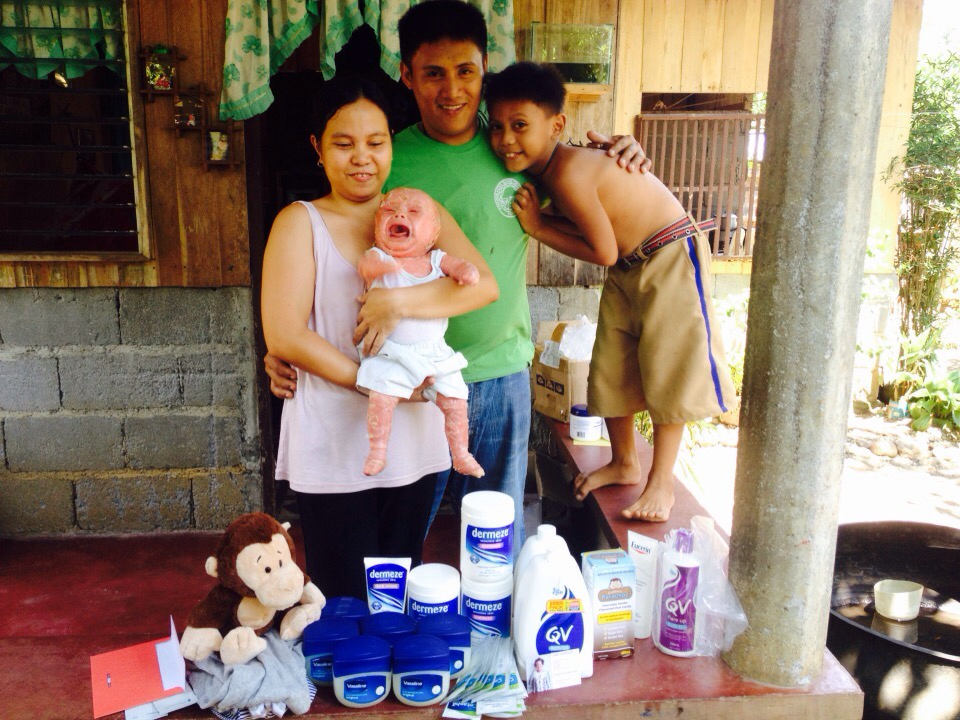
People donated much more than one tub of Dermeze. They donated bath wash and oils and small and large tubs of ointment. They also donated money, so I could purchase more medical supplies to send to Julius. And so I stocked up on Dermeze, QV bath wash and oil, Cetaphil wash, MooGoo wash and scalp cream, eye drops and creams, ear drops, eye wipes, hand sanitiser, Bonds Grow Suits, a fluffy monkey and a present for his big brother.

I was hesitant to send the creams in the post - for a few reasons. People were sending money and ointments and good faith, and what if it was stopped by Customs or stolen? Julius' family isn't a registered charity. Some people in the Ichthyosis community were dubious and discouraging, which disappointed me greatly. Despite all of these doubts, I needed to coordinate help for him. I know the pain of Ichthyosis.

I called a few equivalent churches in Australia - who were unable to provide advice or assist with coordinating delivery - and I also contacted a few people who send medical supplies to other countries for advice. Couriers were suggested, and also registered post. I also spoke at length with Jacquelyn and the church pastor on the phone, who, through crackly lines and broken English, both gave me a promise the medical supplies would get to Julius.

And so I posted the medical supplies by regular Australia Post.

Julius' carer Jacquelyn received the first parcel at her church two weeks after I sent it. She sent me photos of the family, surrounded by creams and bath wash. I had tears. The gratefulness in their faces shows me just how much their lives have been changed.

Jacquelyn said:

"At the time, when we have knocked on doors for Julius and we thought NOBODY will open it, I told Julius's mum to look up and pray, SOMEBODY might open a window and God heard it. He touched EVERYBODY's goodness of heart and sent Julius's an unexpected pour of Love and Prayers, that ANYBODY could wished for. Thank you so much to all of you who sent care packages, love and prayers to this little FIGHTER."

She also told me about the effects the medical supplies have had on Julius:

"Julius can now move his body because of the relief that the creams and oils has given him, his skin doesnt breaks like it used to be so he enjoys sleeping and plays by himself or playing with his older brother even he can't see him, a simple touch and cuddle makes him really happy and Julius loves music, he has 60 mp3 healing songs and some groovy musics makes him happy too. He has reached a milestone considering his condition before and now. It was really a BIG miracle and a big leap of hope for the family. His mum said, before, people are scared to touch or even look at Julius but now everything's changed."

I posted another package two weeks ago. The family received it this week. Look how happy Julius looks. And he's getting baby fat! Cute!

This time I included lots of eye care products as its so expensive. His mum is so grateful. I also included a present for his big brother - a magnetic space landscape.

I've posted over 15 kg worth of supplies so far, and another box will go next month.

Thank you to everyone who donated money and creams, shared the posts, asked how Julius is doing and gave me advice on how to get the supplies to him. Julius is just one baby - of many - that we can help. Through sharing my story and through sharing others' stories, people get to know more about ichthyosis and donate to an individual in need, should they choose.

You can now donate directly to a fund - Jacquelyn will be using these funds to purchase creams in the Philippines.

This is social media used for social good. Thank you for your kindness and generosity. Thank you for trusting that Julius is in need.

(Julius' mum has given me permission to continue to share his story and photos on my blog and social media.)


25 August 2015

When I washed my feet in sparkling water. Knowing the limits Ichthyosis places on me.

Image: glass of sparkling water with lemon and lime. Text: 'When I washed my feet in sparkling water.

No matter how much I say I don't let Ichthyosis stop me, or I can do almost anything despite of it, the reality of Ichthyosis is that it can be limiting. Not just for me but for others too. But it's ok to ask for help, to acknowledge this condition might mean we can't do everything, and to slow down a little.

When I was on the Gold Coast, I caught up with some families I met at the Australian Ichthyosis Meet. It was wonderful to spend time with them again. These are amazing families - resilient, loving and have all experienced similar in regards to their children's skin conditions. Skin, and the management of it, was a common conversation topic. Everyone's skin is affected differently (mine is red and flaky, but the others are white and their skin splits or blisters), and treatments vary too. Some kids prefer the heat and humidity as it helps them, and others (like me) like the cool weather. The kids and I all might start out the day looking and feeling great - relatively smooth skin, nimble bodies - but as we move around and do things throughout the day, our bodies tire and the dry skin makes it hard to move, and the condition presents more obviously.

As one of the mums drove me to breakfast, we were discussing limitations, and how it can be hard for kids to know - or want to - take time out when they get sore, tired or overheated. We talked a little about what happens when we don't have regular baths or put creams on - it can often result in restricted movement and pain. Ichthyosis is a condition where skin and pain levels deteriorate. It is definitely a lesson in maintenance - for kids and adults.

I told her that in the past, it was rare I spoke up about being sore or cold or hot or affected by cigarette smoke or wind, because I didn't want to be seen as being difficult. I didn't want to be a princess. So I put up with it. I didn't act on my limitations because I didn't want to be defeated or look lazy. For years, I walked to and from primary school in 40 degree heat. I know. But with maturity came speaking up and acknowledging I might have to do things differently, or not at all.

I've gone from putting up with discomfort and pain to speaking up (politely) to change things. This usually involves requests for chairs! I ask for a seat on the train if I'm very sore. Sometimes I carry a chair around at a party so I don't have to stand. I ask for seat at concerts (I swapped from standing to the seated area at Lorde, and even perched myself on the side of the stage at a smaller concert). And I often ask for heaters to be turned on or to move out of the sun in the summer. Most recently, I've made the choice to only drive at night if absolutely necessary. Because my eyes get dry and cannot handle the light. It's sometimes not easy to recognise these limitations, and even harder to make others aware of them. That can be a coming out process if people aren't aware of my skin, explaining my limitations.

It has only been in the past seven or eight years that I've discussed workplace reasonable adjustment relating to my skin. This has mostly been time to attend hospital appointments and coming in later/finishing earlier if I am sore and purchasing additional leave as a backup to sick leave. But this year, I focused on physical reasonable adjustment after I felt increasingly uncomfortable at my desk. My feet were sore, I couldn't stretch out like I would at home on the couch (of course!) and I was cold. I never thought workplace assessments for desk jobs were more than ergonomics for the spine and joints. I thought my condition might be too complex to understand or find aids for.

Image: green sheepskin on a stool. Text: an ottoman and a sheepskin go under my desk.

But through talking with my manager, and then an occupational therapist, we worked out some strategies to make me more comfortable sitting at my desk. I now have a reclining desk chair, a bouncy foot rest, an ottoman (which is really just a hospital stool) and sheepskin. I was offered a heated blankie, but worried I'd fall asleep! I didn't ever think my condition warranted an ergonomic assessment - but it's been great to feel listened to and subsequently made comfortable. It's acknowledgement that this condition is as serious as others. I was very impressed with the service.

For an hour on that Sunday at the Gold Coast, we went to the beach. The beach looks lovely to me! But I honestly hate the sand and the cold water. It hurts. The salt is good for me. When the kids paddled in the water, laughing and splashing each other, I thought, maybe I should do so to. I hesitated (a lot), And made the excuse that I am set in my ways. I'm old.

My feet on the sand at the beach

But the kids had so much fun. So then rolled up my pants, took off my boots and socks, and with trepidation, let the waves lap at my feet. It was nice! Fun even. I lasted about 15 minutes. And then I said to my friend that I need to wash my feet and put my socks on without getting sand in them. I leant on her while she washed my feet and put my socks on. We howled with laughter as she washed my feet with no less than sparkling water. That's all she had, I promise!

And then we agreed that for each bath from now on, I'd be bathing in sparkling water. Such a diva. Spilling wine on my skin stings, so I'm not up for bathing in champagne just yet!

Carly findlay at the beach


LinkWithin

Related Posts with Thumbnails