Showing posts with label appearance diversity. Show all posts

19 December 2016

On guard. I'm aware of the need to manage other people's reactions towards me.


The cleaner was due today. Last time they came, they were scared of my face and left

There is usually a different cleaner each time. I know this now I work from home, and also because of the varying quality of the cleaning. 

Part of me wanted to stay home, so I could greet them, smiling in a friendly way, and monitor their reaction. 

Most of me wanted not to be home to avoid being on alert, avoid the explaining of why I look the way I do and trying to make a stranger feel comfortable about my appearance. 

I do just want to get on with my day - do a good job of the work I'm required to for my day job. But I know I'm aware of the need to manage other people's reactions towards me. 

This is tiring.

I acknowledge that of course this doesn't happen all the time, and the majority of interactions are positive. 

But when something like the cleaner being afraid of my face and leaving the job happens, or when I'm abused by a taxi driver, or even when I'm surrounded by high pitched children demanding to know what's wrong with me  I can be on guard. I notice sniggers and glances from my peripheral vision. I see the gaping mouths and hear the sudden silence as I enter their space.

I jot down the cab numbers before I've put my seatbelt on, and I put a smile on so as to not scare the children. 

These are the things I've become accustomed to doing because I look different. 

I try to be polite at all times. But I cannot guarantee that I will respond to each microaggression (or outright discrimination) in a chirpy, educative way. But that's often expected of me. Often by people who experience Ichthyosis - as a carer, and sometimes a patient.

"You should have welcomed this opportunity to educate," I read. It's bitterness, they tell me. There's also the idea that I'm not comfortable with my appearance if I see stares and comments and fear as negative experiences. (Wrong.) 

There is the peanut gallery of people who look on the bright side. Usually people who have never been judged by their appearance alone. "They probably didn't mean it." "It's natural to be curious." Even the "Maybe you're taking things too personally?"

And then there's always my own high achieving self telling me that the way I respond will shape a stranger's experience of dealing with a disabled person or someone with a facial difference. I might be the person to make them never want to interact with someone like me again. It's a huge responsibility to get it right. Amd I don't want to be seen to be scary and difficult. That angry red woman. Because I'm not.
 
The cleaner never came today. I will be on guard another day. And I wonder if something came up, or word has got around the agency to avoid the angry red woman who cried discrimation. 

Has this post helped you or made you think? Do you enjoy reading my blog? Please consider buying me a drink. 

05 December 2016

My face scared my cleaner away today

This is my face up close. It's red, shiny and a bit lopsided because of a dodgy lymph node that flares up because of my inflammation. It's usually very smiley. Sometimes my hair is out of control, and sometimes there's a few bits of wayward skin hanging off my face and hair. This is who I am. 


Earlier this year my face scared the post office worker. Today it scared the cleaner. So much so, she ran away without completing the job. 

It's exhausting having a face that can scare people. Even more exhausting worrying I'm seeming like a victim as I recall events like these. 

I work from home now. Every second Monday a cleaner comes. I usually leave the house to go to the library when they come, but today I needed to stay home until I finished something. 

I greeted the cleaner, saying hello. She jumped, visibly shocked at my face. I let that one go. 

A few minutes later I went out again to tell her to let me know when she needs to vacuum the room I'm in, and I'll move for her. I spoke before I was in the room. As she turned around to look at me, she jumped again. 

I told her "please don't be scared of my face", and said this is just how I look. I returned to the other room. 

20 minutes later, I finished the task at hand, and realised I couldn't hear or smell any cleaning being done. I looked through the house. It's not very big. She wasn't here.

She just left. Didn't lock the door. Didn't let me know. She left because she was scared of how I looked. 

After a couple of calls and texts, I eventually spoke to the cleaning agency manager - angry and upset. The manager told me the cleaner did not know how to react to my face so she left. She was scared of my face and so she left. 

The manager tried to placate me, saying this is a misunderstanding. She said this wasn't cruel or unprofessional, nor is this discriminatory. 

I told her that I'm quite familiar with people's reactions towards me, and I don't need a service provider reacting like this in my own home. She apologised and she will come to clean my unit herself. 

About 15 minutes after the phone call, the cleaning agency manager came and she was extremely apologetic. And empathetic. She did say it's understandable because the cleaner had not encountered someone like me before, and that it's not often I'm home. I said it is not justifiable, and as someone on the receiving end of curiosity and fear, it's exhausting to deal with stuff like this. 

I had specifically chosen this cleaning agency because they gave me a chance to be up front about my skin, and I didn't have to explain it to each cleaner.. I am also really nervous about my skin, so I didn't want to freak a cleaner out about the skin on the floor.  

I asked the cleaning agency manager if I can deliver training to her staff, so they might understand the firsthand impact of such ignorance and unprofessionalism. I said that although the cleaning agent has already spoken to this cleaner, it might help if the cleaners learn the impact of this behaviour from a person who's been on the receiving end of it. 

As I got in the car to go to library, the cleaner was outside my block of units. She was there to give back my keys, which the cleaning agency manager now had. But why was the cleaner still there? I asked if she was ok, you know, just hanging around. No apology. She just looked away.

There might have been more to the story, as a friend asked on my Facebook today. But cultural background and working visas should not have played into whether someone is too scared to do their job they're getting paid for. Would it be acceptable for a waitress not to serve me because they were scared? Or a doctor not to treat me, because of this cultural perceptions of people with facial differences? No.

This is what I envisage will happen. The cleaner will get a talking to. She will giggle to her friends about seeing me. She won't be rostered on to work with someone "different" again. And her small-mindedness and reluctance to see anyone who looks different as human will continue.

Some people who don't get it will say "it's understandable that people are scared" or "of course they'll be startled if they haven't seen someone like you before..." But they will never say "this must be tiring." There's an expectation to be polite, to educate, to take it because my face is unexpected. But I'm angry. And upset.

These are the microaggressions I face - about my face - on a regular basis. It is not up to me to make someone else comfortable about the way I look.

Here's a simple guide for encountering someone who looks different: 

  • Say hello. Smile at us. 
  • Apologise if you showed you are visibly startled. 
  • If we provide you an explanation like "I was born like this", accept it and get on with what you're doing. 
  • Ask polite questions, only if you feel it will add to your day. Preface them with "I hope you don't mind me asking.."
  • Don't just leave a job we've hired you for because you're scared of our faces. 

Has this blog helped you or made you think? Why don't you "buy me a drink" by contributing to my Patreon? Or better still, hire me to give your company some training in diversity. Thanks! 

24 November 2016

This is how two different types of Ichthyosis look, feel and are treated.


I got to hang out with Kyri just before I went overseas. We were in Sydney for an award ceremony . It was so much fun, and we realised how much we have in common. We could not stop talking. 

Kyri and I both have Ichthyosis - but different types. It seemed that our commonalities were more social than medical, though. We thought it would be fun to do a comparison blog post - to show how vastly different two types of Ichthyosis are, and also to show that one treatment does not work for all. Enjoy! 


Her skin is white. 

My skin is red.

Her skin is more resilient than mine. She tells me "my feet are very thick and tough and I can walk barefoot easily, but my skin can be fragile elsewhere."

My skin is fragile, especially on the bottoms of my legs. It's susceptible to infection. 

Her ichthyosis is most obvious on her back and torso. 

My ichthyosis is most obvious on my face - but most painful on my legs and arms.

I use medically prescribed paraffin to moisturise, all over my body twice a day, and more on my face as needed.

Kyri uses Lush Dream Cream on her body and Lush Celestial Cream on her face, and lots of lip balm because her lips crack.
 
Her body has a big skin shed regularly and this makes her feel better. "My skin sheds constantly, and I have four big sheds a year as the seasons change which make me feel tired and a bit cranky temporarily then better after. 

When my body has a big peel (usually about once every 18 months, but now more frequently), it's so painful.

Kyri takes accutane which is really helping her. She says accutane is wonderful because it makes life a lot less painful. She says "Accutane reduces the thickness of the scales a lot and stops the skin drying out so quickly, but makes my skin much more fragile (grazes become cuts) and susceptible to sunburn."

I'm not on any regular drugs. I take antibiotics and painkillers occasionally. 

We both feel pain. 

I am susceptible to infections.

Kyri used to get infections more often than she does now, again accutane - pre accutane my skin would split open along the scale lines regularly. 


She doesn't feel the cold as much as me.

Kyri's feet soles are thick with skin. 

My feet aren't as thick with skin. 

Kyri has very long, thick hair on her head. She also has body hair. 
Mine doesn't grow long, is thin and slow at growing. I have no body hair. 

My scalp has obvious scales.

Kyri's scalp doesn't have many scales. She told me "my scales in my scalp were much more common pre-accutane, by the way. I'd shed everywhere a lot more, too."

She told me she doesn't shower frequently, because water makes her skin too sore. "My skin dries out and shrinks together causing splits, and it's also much much more itchy for about 24 hours", she says.

Meanwhile, in the time we spent together (3.30 pm Wednesday -
12.30 pm Thursday, I'd had two showers. My skin body would feel so uncomfortable without a shower.

Kyri woke up with her face looking like it did before she went to sleep. 

I woke up with my face scaly and unable to move it.


Kyri'a hair is so long and silky. "My hair also grows very fast. I have less body hair than most women, but I have more than you", Kyri says.

My hair is short, and breaks off. It doesn't grow much. I have almost no body hair. 

I find it it more comfortable to wear tights and long sleeves every day. This keeps me warm and protected from the elements and scratches. 

Kyri can't cover up as much as me or she would overheat. She is fine wearing short sleeves. 

We both get tired easily - Kyri probably more so than me. 

Kyri sweats a little.

I don't sweat. 

I don't have eyelashes and only sparse eyebrows. 

Kyri has both eyelashes and eyebrows! So envious! 

We are both shorter than average. 

We have both felt self conscious about our skin and have covered up to avoid embarrassment. We have become less self conscious as we've aged. 
 
 
We are both very outgoing, and we talk and laugh a lot. We both love fashion and taking selfies. 

Our treatments vary. What suits me doesn't work for Kyri. When you suggest a product that you love, don't assume it will work for everyone with ichthyosis. See my medical shaming post for more on that. 

We don't look the same but we both have Ichthyosis. 

Has this blog post helped you or made you think? Please consider buying me a drink to show your appreciation. Thanks for reading! 


Have you listened to my podcast yet?  Listen to Refreshments Provided here.

21 November 2016

Seven books to help kids with Ichthyosis (and help kids learn about Ichthyosis).


Last week, a mum in one of the Ichthyosis groups I belong to asked about books to teach kids about Ichthyosis (and visible difference). The thread was soon filled with suggestions - and I asked if I could collate them and others I've found useful into one blog post. They said yes, of course. It's a great community.

I've put together this guide to books suitable for young children, older children and parents, and also some school resources for parents and teachers. They are relevant for kids and adults with all sorts of visible differences too. Among them, three of them have been written by parents or grandparents of children with Ichthyosis, and four are by Australian authors. Perfect! I've read them all!

If you are parents of children with or without visible differences, I'd love it if you could take some time to read this, to help teach your kids about what it's like to look different. Reading just one of these books to them might just make the difference to a little one who is excluded because of the way they look. 

I hope you find these useful. 

(There are no affiliate links here, and ice tried to source Australian retailers to support local. A quick Google of each will take you to international retailers.)

Books for younger kids:

Maddy and Ma - Barbara Jarvis


Maddy and Ma, by Perth-based Barbara Jarvis, is based on a true story - the bond between a little girl and her brother (who both have Ichthyosis) and her grandmother. 

Barbara told me

"Maddy and Toby have learnt there are certain things they can’t do because of their skin condition but their family have always focussed on what they can do rather than what they can’t do. I think it’s so important that we instil in our children a sense of self-worth and a positive approach to life, whatever their situation.

Maddy and Toby have grown up used to regular visits to the “skin doctors” and daily “creaming” to ease their skin’s dryness and itchiness because they “have a skin condition”. I once saw a TV documentary on dolphins and learnt about the rare pink dolphin. It struck me that Maddy is like that rare and very special pink dolphin. She loved the analogy."

Buy Maddy and Ma here. (Proceeds go to the Perth Children's Hospital Foundation.) 

True Blue Hand - Ainsley Kyder-Gould
 

Written by my friend Ainsley Kyder-Gould, whose young daughter has Ichthyosis, True Blue Hand helps to start a conversation about appearance diversity. 

Ainsley wrote about the book on my blog earlier this year.   

Ainsley and her beautiful family live in Melbourne and I love catching up with them.

The website's blurb: 

"True Blue Hand is a sweet tale of a little girl who happened to be born with a unique blue hand. Through a children’s conversation at the park the story promotes a positive example of how to be curiously kind when dealing with uniqueness."


Elmer - David McKee


I was recommended Elmer by Random House, who provided books for the kids at the Australian Ichthyosis Meet in 2015. I used some of the crowd funding to ensure all the little ones had this book. Some mums have told me the book has really helped their kids. 

From the Elmer website

"The stories are suitable for early exploration of the themes and issues relating to the concept of diversity, as Elmer discovers that when he tries to change his appearance in order to 'blend in' with the other elephants, they no longer recognise him, or accept him as one of their own. This makes Elmer sad, and he experiences how it feels to be treated like an outcast, after being ostracised by his old friends. It's only when it begins to rain, and the grey paint that Elmer has covered himself with starts to disappear, that Elmer's 'true colours' are revealed, much to the surprise and delight of his friends, who preferred his multicoloured and fun loving persona. Following their happy reunion, the elephants reassure Elmer that they love him because of his differences, and not in spite of them, and they celebrate by painting themselves in multi-coloured paint, in recognition of Elmer's unique appearance and personality."


Books for older kids 

Ugly - Robert Hoge
 

Ugly, by Robert Hoge (from Brisbane), is an adaptation of his 2013 memoir - especially for young readers. I did an interview with Robert here.

From Booktopia: 

"Robert Hoge was born with a tumour in the middle of his face, and legs that weren't much use. There wasn't another baby like him in the whole of Australia, let alone Brisbane. But the rest of his life wasn't so unusual: he had a mum and a dad, brothers and sisters, friends at school and in his street. He had childhood scrapes and days at the beach; fights with his family and trouble with his teachers. 

He had doctors, too: lots of doctors who, when he was still very young, removed that tumour from his face and operated on his legs, then stitched him back together. He still looked different, though. He still looked ... ugly. 

Ugly is the true story of how an extraordinary boy grew up to have an ordinary life, and how that became his greatest achievement of all."


Wonder - RJ Palacio
 

Wonder is written by RJ Palacio and I've devoured it in a day. 

Wonder is a fictional children's book about August (Auggie) Pullman, a young boy born with a facial difference. He's got a genetic condition which affects his facial structure and his hearing. RJ Palacio was inspired to write this book after an encounter she had with her sons and a little girl with a visible difference. As a reader with a visible difference, I will say that it's very well researched. It could well be an account from an actual person.

On the first page, Auggie says:
"I won't describe what I look like. Whatever you're thinking is probably worse."

We never know what Auggie looks like but we get an idea from how he's treated.

Wonder documents his first year in mainstream school - the challenges of making new friends and fitting in. The descriptions of being a primary school student who looks different brought back many memories for me - it's interesting reading it from a young character's perspective when I've experienced similar. Auggie is teased, excluded (some of the other students invented a game called The Plague, where they believe if they touch Auggie they'll catch something), and physically bullied. He has a few genuine close friends but it takes a while to feel accepted.

My review is here.

This has been one one of my favourite books of all time. Again, I gave all of the older children and adults with Ichthyosis a copy at last year's meet. One of the tweens who attended told me she treasures the book. 


Ride High Pineapple - Jenny Woolsey
 

A blog reader turned friend wrote to me to tell me she has penned a booked called Ride High Pineapple. Jenny Woolsey, also from Queensland, has Crouzon syndrome, and her daughter does too - so she has firsthand knowledge of what it's like to live with a visible difference. 

It's the story of Issy, who has a facial difference, getting bullied and then developing a strong sense of resilience through finding a hobby and having an adult mentor to show Issy her worth . It's a great book for young teens. 

I enjoyed this book and wish I had it when I was a teen. 


Books for parents and teachers 

A Different Beautiful - Courtney Weatlake
 

Written by Courtney Westlake  mum of Brenna, who has Ichthyosis, A Different Beautiful is a journey of raising a child with Ichthyosis. I found it to focus on religion more than Ichthyosis, but it has some good messages about how to talk to children about visible difference. 

This passage was my favourite of the book. 

"More times than I can count, I have been thrilled when a family has approached us who has recognized us from social media, wanting to say hello… only to be dismayed when that family’s children stand back and furrow their brows at Brenna’s appearance. It is clear that although the mother has apparently enjoyed reading about our daughter and seeing our family’s photos online, she never took the time to share with her children. Often mothers will share with me how Brenna’s story has helped changed their perspective regarding special-needs parenting and differences, but then, it is obvious by the confused reactions of their kids that they haven’t yet thought to pass those lessons on to their children. If we allow stories and experiences to inspire us for a moment, or even to begin changing our hearts, but we don’t take the time to show our children and teach our children about these new perspectives, we are missing the point. If it starts and stops with us, we will never see real and lasting change in the hearts of those around us and in the way our children see themselves and treat others."

These resources I've collared are so needed because, as parents tell me, their children with Ichthyosis are still being teased and excluded at school. It might well be because parents aren't talking to their kids about appearance diversity. 


School resources 

The Ichthyosis support group in the UK has an excellent pre-school and primary school resource - for teachers and students. Download that here.  The Ichthyosis Support Group also has a story booklet that you can get here.

Changing Faces school resources  features information for teachers and students at all stages of the education system. View those resources here. 

It also features a kit on teaching Wonder

Of course, I have also written a lot of information about coping with Ichthyosis on this blog - including:
Are there any more resources you recommend?

Has this post helped you in some way? Perhaps you'd like to buy me a drink for my efforts in writing this blog. 


02 November 2016

The death of 11 year old Bethany - bullied because of her appearance

Content warning this post contains details of bullying and suicide. Crisis line details are at the bottom of this post.

Bethany Thompson, an 11 year old girl from Ohio killed herself because bullies became too much for her. I read the news report and couldn't hold back the tears.

They bullied her because of her appearance - a crooked smile that was caused by the cancer treatment she had when she was three, and her curly hair.

On her last day of school, she and her friends wanted to put up posters for an anti bullying campaign. The posters read "buddies, not bullies", but the school wouldn't let them. 

She told her best friend she couldn't take being bullied anymore, and killed herself on 19 October. 

It breaks my heart to read this.

Look at her. A beautiful girl, hoping to change the way students treated their peers - hoping to change the world, and she was denied that empowerment. A girl who received life saving treatment as a toddler, which should never have affected how others perceived and treated her. Now she's gone, far, far too young.
(Photo from Columbus Dispatch)

Schools need to take this behaviour more seriously - to listen when kids report bullying, and to let kids lead anti bullying campaigns.

Parents (and peers) need to show kids what bullying can lead to, and step in to say that's not ok. They need to take responsibility and action for the way their children treat others. (Alison left a great comment on my Facebook post about this.) There was a great page in Courtney Westlake's book how parents are responding well to her blog about Brenna who has Ichthyosis, but this acceptance and awareness isn't being passed down to their kids through discussions about looking different. These discussions need to happen. - they need to trickle down to children.

I also think medical support groups need to provide children and adults with tools to build resilience and assertiveness, just as much as they provide medical advice. Perhaps a buddy system - pairing up children and adults with facial differences, could offer hope and peer support. I know that would have helped me.

Most of all, emotional intelligence - encompassing diversity, compassion and empathy needs to be taught as a standalone subject in schools. Kids need to see that Bethany and those of us who look different are worth getting to know, and that they need not fear or ridicule difference. I really love this resource - especially this:

"Strategy: Nobody should exclude another student from sitting next to him or her and/or from playing with him or her.

Why: It will hurt the feelings of that student. You have an opportunity to make a new friend." It's great to see the onus of stopping bullying being placed on the bullies, rather than those being bullied." 

This little girl was loved by her family and a group of friends but that wasn't enough for her to know she was worthy. 

I wish some of us adults with facial differences could have known Bethany and taken her under our wings and said "it gets better". That she could be her own hero.

This was me age nine. I wanted to die because of the way children bullied and excluded me because of my skin. Friends tell me they were bullied to the point of wanting to end their lives because of their visible differences when they were children too. Years later, it's still happening. It has to stop. It's too sad to comprehend.

Rest in peace beautiful, smart, kind Bethany. I'm sorry you were treated this way. My thoughts and love go to your family and friends. 

There is a gofundme to help Bethany's family with funeral expenses. Please drop them a few dollars if you can spare it, or share the link.

Support:

Lifeline: 131114, Kids Helpline: 1800551800, or the crisis line in your country.

Changing Faces and YP Face It are also good resources to help young people with facial differences.

I am not a doctor nor a psychologist, but I have lived experience in living with a facial difference. You can always reach out to me, too.

19 September 2016

Ichthyosis in developing countries: the stigma experienced in Africa.


In July I was alerted to some children in Wajir, Kenya who are suffering terribly from Ichthyosis. I rarely use the term 'suffering' but these children really are. My heart breaks for them.

The children haven't received adequate medical treatment and are hidden from their community. I've been told that children with disabilities are killed or left to suffer. Their families and communities believe it's witchcraft that caused Ichthyosis, and bear great shame in having a child that looks different.

I was told differing information about the children – I don’t know how many children are affected by Ichthyosis, and when trying to get in touch with one boy’s immediate family (Baby Abashir, below), two men initially claimed to be his uncle, and later told me they are just part of the campaign to save these children.

An aid worker contacted me on Twitter and then by email. She said the children have a dermatologist and creams. But she couldn’t give me exact information about how I could help – where to send creams to, how to get information about care plans and emotional support to them.

And the Foundation for Skin and Related Types (FIRST) tweeted at this aid worker offering only a teleconference between the Kenyan dermatologist and FIRST, but the infrastructure in the town of Wajir doesn’t allow this.

There has been a social media campaign (#savewajirkids) which has raised a lot of awareness that these kids exist and need help. But sadly, a lot of it is clicktivism - sharing tweets and expressing sadness, without offering tangible help.

I worry about the speculation created in the #savewajirkids social media hashtag. A lot of misinformation has been spread - including how Ichthyosis might have been caused by nuclear waste. And there are tweets expressing horror about the image of these kids. I don't agree with these kids' photos being used for speculation if there are no facts to back them up. Yes, awareness needs to be raised, but the kids need their dignity, respect and tangible help. A tweet will raise awareness, but won't help these kids. A treatment plan and ongoing support will.

And I didn't see many people in the Ichthyosis community talk about these kids. (I wanted to help them like I helped Baby Julius - but I could not do it alone.)

The same week I was alerted to the Wajir children via the hashtag, I was contacted by an ABC journalist based in Kenya, who is committed to telling the kids' story sensitively - to educate the community and to reduce stigma. He wanted to cover this story, but I am not sure whether it’s been published yet. In a lengthy email, I told him about my treatment and the support I receive, and what might help these children. I only hope he has passed the information onto the children’s families and dermatologist, even if the article has not been written.

So with the futility of contacting the aid worker, the men claiming to be family, a brief response from FIRST, and the cessation of the journalist's emails, I don’t know how else to help these children, which is why I am writing this blog post.

I felt a terrible sense of privilege explaining my situation to the journalist, because I know just how little these children have - in terms of medical aid and understanding. And I’m reminded of the life-lottery – I believe my life would have been a lot different if I was born elsewhere. There would be a different healthcare access, and also different attitudes towards appearance diversity and disability.

In reading about the Wajir kids and answering the journalist’s questions, I've realised how lucky I have it. How lucky so many of us with Ichthyosis who are born or adopted into the first world are. While I have access to medical treatments such as ointments and antibiotics, sadly these children do not. Their skin has deteriorated so much. And I've never faced this type of stigma and discrimination faced in Africa. (I know others in Asia who have experienced similar stigma.)

I don't know whether my advice to the journalist was useful because there's still so much more to be done in terms of rigorous treatment to get the kids' skin to a manageable state before commencing routine ongoing treatment, and of course, encouraging acceptance and inclusion in these communities. Additionally, good health is helped along with good nutrition, and families might simply not have enough money and access to nutritious food to ensure their children with Ichthyosis are eating well. I know how painful the condition is and I can't imagine the pain these kids ensure when it's gone untreated for so long. I am very sad for them.

In 2014, Jennifer See wrote about Ichthyosis in Ghana on her blog Confetti Skin. Jennifer wrote:

"The youngest child is Amotalé. Michelle told me that while Amotalé is 10 years old, she is only the size of a healthy 4-year-old. Her name means, "Has it gotten to this?

She has scurvy from vitamin C deficiency and walks with a stick because her legs won’t straighten around the thick scales on her joints. She has severe malnutrition and her belly is distended. Her poor head is so thick with scale that it is like a cap. Michelle told me that two days ago, when she gave Amotalé a bath and removed some of the scale from her head, she saw the skin underneath was leaking pus and was infected. A separate Facebook post from the same day even says there were maggots underneath her scalp. Michelle said that Amotalé hated the bath, but once she was done with lotions, the little girl started dancing."

There are others living with Ichthyosis in similar conditions across the world (Nepal and India). The stigma and lack of knowledge about the condition and access to treatment is very similar to what the children in Africa experience.

I have an online friend with Ichthyosis who lives in Kenya. Esther, in her 30s, wrote to me outlining some of the experiences she has had, as well as some advice. She has just got married! I wanted to get a sense of what it’s like to live with such a rare, stigmatising condition there, and she has given me so much insight. Esther has met with Baby Abashir and his family to provide them with advice and support. (I have edited her words a little for punctuation and grammar.)


"I have lived with the EHK Ichthyosis all my life. It was very difficult for doctors here to understand it know what was wrong with my skin so it was such a hard time for my parents. In those young years nobody gave them the right diagnosis so I was grouped with all others who have the common skin diseases. I saw my dermatologists with no success.

I am happy with my skin, it had improved so much I no longer itch or get blisters which were so bad in my years. I am now on creams that a doctor who is good on alternative medicines. I also exfoliate my skin which makes it smooth. I am also on whole grain diets which has helped my skin.

What baby Abashir us going through with his family is what we went [through too]. I have faced isolation, stigma and discrimination in different aspects of my life since not many know or understand what Ichthyosis is. And doctors too, I have faced difficulties with them too when I try to explain to them.

I do work am self employed in informal sector - I sell handbags which I love. That's how I manage. I can say that am fortunate my family loves and accepts me, so I am confident.

But I am sad to say kids with Ichthyosis are hidden, not educated and even are abandoned by their families. The culture here contributes to this because they believe it's witchcraft.

So children and adults in the most remote parts of Kenya continue to suffer in silence.

My dream and hope is to reach them and offer them hope and support so a fundraiser us great so that the money we get [can] help baby Abshir and other in Wajir. This part of Kenya is most affected with my children suffering. It’s a very hot place so heat intolerance is so great.

I don't know what we can do any suggestion in this is great so basically we would need help with creams, eyedrops, and even monetary so we can be able to achieve the goal of reaching out to this other kids. Mostly I need to travel there to create awareness in this community and connect and give them moral support."

The journalist told me that when the Wajir children’s parents were told Ichthyosis is a genetic condition, they blamed themselves, believing they caused it.

Oh my heart.

Parents, please don't blame yourself. Many parents don't know they carry the gene until their child is born with Ichthyosis, though it can be screened for during pregnancy. (My parents didn't know, and they've since been genetically tested and both carry the gene. It was passed to me recessively.)

The children have been hidden away from their communities – because disabilities carry a lot of stigma and shame in third world countries. Again, tears.

These kids need to be shown love and compassion and that they're a valuable part of the community. It starts at home and with medical staff. Communities need to be made aware of disabilities - that they aren't caused by witchcraft and that people with disabilities aren't to be hidden away and ashamed about.

The stigma is as painful as the skin condition.

In a paper titled Reducing Stigma and Discrimination to Improve Child Health and Survival in Low- and Middle-Income Countries: Promising Approaches and Implications for Future Research (Nayar et al, Journal of Health Communication, September 2014), academics discuss the impacts of stigma on the development of children with chronic illnesses and disabilities.

"The manifestations of stigma can lead to a number of stigma outcomes, such as delayed treatment seeking or poor medication adherence, that ultimately lead to longer term stigma impacts, including poorer quality of life and increased morbidity and mortality. For children under 5 years of age, stigma and discrimination experienced by parents—for example, as a result of having a stigmatized disease such as HIV or belonging to a stigmatized group such as the scheduled caste in India—can impede access to or uptake of available health care services, leading to poor health outcomes for children."

The paper suggests stigma and discrimination reduction methods should be implemented into infant and child health programs:

"Increased investment in stigma and discrimination reduction interventions and program evaluations is also needed to overcome the evidence gap regarding stigma and discrimination reduction interventions. Program implementers should prioritize regular inclusion of measures that assess stigma and discrimination in evaluations of all interventions targeting neonatal and child health and healthy early childhood development, including interventions addressing integrated care of mother and child. The field would also benefit from improved, more detailed reporting about the content of community engagement, communication and counseling…"

I am concerned that the stigma around these children has prevented them from receiving adequate education opportunities, thus preventing them from entering the workplace, and perpetuating a cycle of poverty. Esther’s story is proof that the stigma can be broken.

Another academic paper I read (The Stigmatization of Disabilities in Africa and the Developmental Effects - Digital Collection, 2013) states:

"It is widely believed in areas like Africa where stigmatization creates negative connotations that the employment of persons with disabilities would cause a less productive workplace, due to special needs and slower production rates." The paper provides examples of terrible human rights abuses, but also provides suggestions of the benefits of inclusive education, as well as inclusive advocacy efforts to help shift attitudes of governments, policy makers and financial institutions. "One example of how this can be accomplished is in the case of AbleChildAfrica http://www.ablechildafrica.org/, where children have a say in everything they do. The Board meets with the communities two to three times per year and consults with their local partners regularly. These partners work with children everyday so they see what works and what does not in terms of program implementation. The partner organizations also work with the families of the disabled children in order to move away from the idea of just leaving the child to be taken care of by someone else and not included."

Ethan, who is 10, wrote some advice for these children. He wants these children to see they're not alone. I love his wisdom.

"Having different skin is nothing to be ashamed about. I have Ichthyosis just like you😀. Even though you have different skin you should know that you are the same as anyone else on the inside. I know it must be hard to stay cool in the hot weather in Kenya. We're all the same, if I had went with my mom she would have treated me as well as she could in that environment for even a week or two. It can be hard even here in North Carolina where it's cool some of the time. Even now my skin has been through a lot more than most people. Even with lotion and a cooling vest I still can get really hot and uncomfortable here. I can only imagine how much more challenging it could be with so few resources.

My mother told me that you are having a lot of trouble getting the supplies you need. I was glad to see you were more comfortable with the lotions that you got in Nairobi."

Here's a photo of Ethan and his Mum Erin. Erin is incredibly proud of her son.

So here’s what I’d like the parents of the Wajir kids, and the wider community, to know about Ichthyosis. It seems so simplistic, with the complexities of the treatment and perception of disabilities in the third world, but it's all I can do.

  • Ichthyosis is a genetic condition.
  • It's genetic and not contagious.
  • There are many types of Ichthyosis with varying symptoms, appearances and treatments.
  • Regular showers and baths in clean warm water, and applying ointments such as Vaseline can help.
  • Adequate nutrition helps - fresh fruit and vegetables, meat, dairy, plenty of water.
  • Once the children's skin is managed, they should be encouraged to get an education, form relationships and get jobs.
  • You are not alone.

Here are some other resources from medical experts about treatment:

From the Royal Children's Hospital, Melbourne,

From Dermnet, New Zealand.

I can only hope that now these children in Wajir have been "found" and received some media attention, an education program can be provided to their parents, medical staff and the wider community. As well as reducing stigma, they could get the medical treatment they need, as well as being included and valued members of their community. I also hope their doctors can look to adults and young people with ichthyosis to see how we’ve managed, and also to show these children and their families that a good life is possible. While it has been hard for me to connect with this community, I hope that this blog reaches them somehow, and they can see they aren’t alone.

If you live in Africa and want to tell your story of life with Ichthyosis, you are most welcome to leave a comment below.

This is the second post in my series "Ichthyosis in developing countries". You can read the post about Ichthyosis in India here.


16 September 2016

Australian Centre for Leadership for Women Diversity Awards

On Wednesday night I had the pleasure of attending the Australian Centre for Leadership for Women Diversity Awards in Sydney.

From the website:

"ACLW’s Awards Program commenced in 2006, culminating so far in three national awards for women’s advancement, with more than 60 national recipients being recognised and awarded, including women, men and organisations. This year is ACLW's 10th Anniversary of its Awards Program for women's empowerment. The 2016 Diversity Award refines the spirit of ACLW's Award Program as it seeks to platform in a mainstream forum, recognition for community and organisational initiatives in Australia that value and empower women in Australia who come from diverse backgrounds, and particularly from groups that are marginalised."

Dr Diann Healey Rodgers runs the Australian Centre for Leadership for Women voluntarily and entirely on her own.

We were treated to performances by the Sydney Gay and Lesbian Choir and a troupe of Greek dancers. The presenters included Prue Goward, Christine Forster and the speaker of NSW Parliament House Shelley Hancock who was hilarious.

I was a second place winner in the Disability category. I won because of my work organising the Australian Ichthyosis Meet. The category winner was Women with Disabilities Victoria (who I am doing some work for next week) and the third place winner was South East Centre Against Sexual Assault. Here are the two other category winners - Keran and Dagmar.

Every first place winner made a speech and they wowed the room. From domestic violence support and refugee welcoming to providing child care for women in medical research and climate change research and prevention, the work these women do is so important.

I am so honoured to be recognised in a room full of amazing, accomplished and diverse women truly making a difference In Australia.

A big congratulations to Kyri Fuss for being a co-recipient - one of the 75 beneficiaries of the Australian Ichthyosis Meet. And thanks to the Australian Centre for Leadership for Women for the award, Professor Ingrid Winship for the reference and ongoing support, the Ichthyosis community especially the attendees, the supporters of the Ichthyosis meet who made it happen, my wonderful Adam and parents, Layne Beachley and the Aim for the Stars Foundation, the Awesome Foundation, FIRST and UK Ichthyosis Support Group and my wonderful blog readers and social media followers for helping me along the way. ❤️

In my entry, which Kyri (above) provided a supporting statement for, we both said the meet was something we could have done with when we were young.

Oh and if you think my life is all pretty dresses, fancy meals and glamourous award ceremonies - you'll be pleased to know that I am grounded (literally).

After the awards ceremony at Parliament House, Kyri and I got back to the hotel, I bought some cheese and crackers, and then got changed for bed. As I came out of the bathroom, the heavy door closed on me, making me slip on the carpet and pushing me over. I hit my head, knee, shoulder and bottom. Ouch but laughing. A bit bruised now!

We stayed up til 11 pm raging to This American Life podcast (I fell asleep halfway through the first act).

Ha!

You can read about all the winners here.


12 September 2016

Ichthyosis in developing countries - India


Last week, an article was published about two young siblings in India living with Lamellar Ichthyosis. The article describes the children as having snake skin.

Sayali (13) and Siddhant (11) Kapase live in Pune, India. The children, along with the parents, Sarika and Santosh Kapase, spoke to journalist Charnamrit Schadeva about the struggles of living with Ichthyosis.

The journalist's Twitter account shows she specialises in writing about children with facial disfigurements and rare medical conditions. The article about the Kapase children sits above previews of these types of articles. Like many other articles about Ichthyosis, the language is disempowering, and while it does raise awareness of the condition, it also heightens stigma. (One article about the children in a different publication came with a graphic image warning.)

The article covered the treatment the children undergo, and comments from a dermatologist (he assures readers the parents are not related, and speaks of the parents both having a "mutated gene", so Ichthyosis "was unavoidable for the children". But it's the attitudes towards the condition that concern me.

My heart hurts for these children, who do endure prejudice and exclusion from "frightened locals" because of the way they look. They were denied entry into several schools, and the children at their current school are too scared to play with them. They have little confidence in themselves, and really, can anyone blame them?

From the article:

"Sayali, 13 said: "I'm disgusted when I see myself in the mirror. I wonder why God made my brother and me this way. People call us names like ghost and witch. I aspire to be an accountant but I wonder if anyone would offer me a job with this condition."

The article continues:

"Sarika now worries for Sayali's marriage prospects in the future and wonders if any man would accept her as a bride."

"I cannot dream like other mothers do for my daughters wedding", she said. Every mother has aspirations to see her daughter growing up and getting married. I do not feel the same. No mother would like to see her children in this condition."

It's terribly sad that even their parents have given up hope. I hope that they can see that there are many of us with Ichthyosis who have been educated, found love and have good lives. If their parents do not have hope, how can the children feel good about themselves?

What I hope this family can know:

  • Your children are beautiful, smart, articulate and kind.
  • You are not alone.
  • There is support out there. There are Facebook groups to connect with other parents and children, blogs (mine, DeDe's, Courtney's, Mui's and more.) The Ichthyosis Support Group and FIRST have good resources too.
  • Never be ashamed of your children.
  • Many people with ichthyosis lead active and fulfilling lives - with education and careers, relationships, friendships and travel.
  • Medical support is important but emotional support is just as important.
  • Focus on managing the condition day to day instead of worrying about the future.
  • Pride and esteem in your children starts with you. Be proud of your children - and express this pride to people you meet.
  • Self love is important. If these kids can love themselves, then love will come to them.
  • Please be careful what you say to the media. Media covering Ichthyosis can be exploitative and voyeuristic. This can have a huge impact on your children's esteem as well as the wider ichthyosis community.
  • It gets better.

A friend sent me this article in the Guardian the same day I read the article about the children in India. The article addressed the way girls and women with disabilities are treated in countries like India, where women are expected to marry - except women with disabilities are not.

Nidhi Goyal writes:

"Kasturi, an Indian girl with polio, wants to marry but her mother believes no one will have her because she will probably be unable to take care of the house.

Women with disabilities make up roughly 5% of the world’s female population, yet many are not considered "woman enough". Their capability is questioned – can she cook? can she raise children? – along with their sexuality and entitlement to equity or rights. If they fail to meet idealised expectations about how a woman’s body should look, they are deemed incapable of providing care.

Sadly, this view of women with disabilities being "broken" or of less value has been adopted by the women’s rights movement, which has been slow to make space for them – if not actively resistant."

Reading Nidhi Goyal's words made me think of the (low) expectations Sarika Kapase has for her daughter Sayani's future. But I was very aware of me not being the right person to make an informed comment on the family's despair. I can't fully address this without coming across as a first world privileged white (red) saviour.

While I have lived with Ichthyosis my whole life, I don't know what it's like to live in developing countries.

I experience staring and comments, and the pain of course, but in Australia, the stigma around the condition is almost incomparable. I acknowledge my western privilege and also the complexities of visible difference and disability in other cultures.

While I wrote "it gets better" in my advice list, I don't think the attitudes and access to treatment in developing countries ensure that it does get better.

So I asked my friend Tina to write about her experience with ichthyosis in India. Tina has written her story here before, and some readers donated through this blog so she could get a cooling vest. Tina has the same type of Ichthyosis as the Kapase children.

Here's Tina's story of what it's like to live with Ichthyosis in India - from the physical aspects to the reactions and ignorance of other people.

"I was born as a colloidal baby with severe or chronic type of Lamellar type 3. I have severe challenges handling both cold and hot temperature. I work as a Training consultant.

The reaction of people is quite visible, The facial expressions , some stare and some just don’t like the sight of me, it seems they are horrified by my sight, I am emotionally, mentally and physically down in every aspect. Every time I think today will be a nice day, but the snide comments and stares all mar my day.

I started taking Acetretin since 3 years. From my bath , scrubbing, washing and creaming it takes 3 hours to get ready. I am totally exhausted and drained even before my day begins. Simple chores seem a herculean task. I wear clothes that cover me from head to toe, be in Summer, Winter or Autumn. I spend ¾ of my salary on the medicines, Vaseline, creams, Glycerine. Icthyane, Glyco A cream, Band aids, Cotton bandages and swabs, Eye drops to prevent eyes from drying. I have bathe 2-3 times a day and wash face and hands many times at work as skin gets dry, scaly and poky all over.

I do not have any medical treatment available in India. The dermatologists are still clueless about my condition. The medicines and creams and lotions that I use is from the ideas and suggestions shared by FIRST group that I met on Facebook 4 years ago. Indian government should include Icthyosis under sever disability category. I cannot take leave from work as they say if you want to work here you have to be healthy. The people in the corporate world also should understand us. At work place, I told my colleague that I have to travel to see a visiting dermatologist, he was coming from London and I wanted to go, The colleague says you can go next time, They are that ignorant in India.

It’s not only the superficial layer of skin that is affected, Due to Ichthyosis, I have very low levels of Calcium, Vitamin D, Vitamin A, Vitamin E, Potassium and Magnesium, all these minerals are deficient or absent. My head and scalp are so bad that it scales, sheds and itches very badly. I scratch so violently that the scarce or just a handful hair falls, making it even scantier. Even if I squat or sit on the ground the skin stretches in several places and immediately snaps and fine cuts appear all over. I do not remember a day being free from physical pain. I feel it’s a part of me now. Pain and I are synonymous with each other.

I am highly Myopic and the being visually also makes my life difficult. I am blind in right eye due to Glaucoma. The left eye is highly short sighted.

The reactions to my skin changed over the years, but just a little. Very few understand and empathize. There are some who blatantly tell that I ask for self-pity, I get upset when I do the same amount of work that others do but for me I go through a lot of pain physical and emotional and still they do not acknowledge and this makes me more bitter.

Parents and Family are the greatest support system. I am proud that my Mom was my biggest support system. People treated her badly saying that she was a sinner that’s the reason I was born in this condition. My own cousin called me names as I have leprosy, she is married and 40 years.

There is a Man Called Sai Charan from Nalgonda. He has Lamellar Ichthyosis . He never used Vaseline or Glycerine as his dermatologist never suggested anything. He uses only coconut oil. He is looked after by his old grandmother who earns a meager income. He is worried about his future and always is depressed. He says that life is laborious for him. He does not know that we all go through the same stage. There is Nagesh from a remote village in Telangana. He has two sons who are affected by Lamellar Ichthyosis. He too is seeking financial assistance from the government, but no avail.

There is a lady, Gloria, who has Vulgaris Ichthyosis, I buy her soaps a, Vaseline and Glycerine for her. She works in a school. Her hands and feet are cracked and bleed as she is constantly in water. The Principal of the school does not allow her to work inside the school and she is outside in the hot sun the entire day. The School Principal says that she cannot allow Gloria to work indoors as the school children will get frightened and scared by her appearance.

Even in the church she sits behind in a corner as people don’t sit next to her because of the odour that emits.

I get angry and upset when I see such articles. How can educated people use such statements? I feel they don’t have values.

[To those without ichthyosis and disabilities]: Please understand that what we have and go through is not easy for us. We are already Physically, Emotionally and Mentally distraught. We too long to lead a normal life . There are many things we cannot do, as the pain in the bones is almost crippling. And the cracks and fissures are painful and bleed under duress. Please understand us and have patience with us."

I wish Siddhant and Sayali all the very best with their treatment, and I hope they reach a level of positive self acceptance once day. I hope this post is passed on to their parents and their community.

If you live in India and want to tell your story of life with Ichthyosis, you are most welcome to leave a comment below.

This is the first post in my series "Ichthyosis in developing countries". The next post will be published soon.


09 September 2016

Robyn Lambird and Madeline Stuart - Aussie models with disabilities rocking the fashion world.

Robyn Lambird and Madeline Stuart - Australian models with disabilities rocking the fashion world.


It's an exciting week for disability-inclusive fashion - from chainstore to runway. Two young Australian women featuring in the Target catalogue and in New York Fashion Week.

This week, Target features a young woman with a disability in its catalogue. Robyn Lambird, who uses a wheelchair, models activewear. Above her smiling face, she's quoted: "As a para athlete, I practically live in activewear. That's why I love Target's range - it's got me covered for the who,e day. With plenty of options for working out, and fashionable pieces, that are perfect for busy days in between training sessions."

I chatted with Robyn, who has cerebral palsy, about how modelling for Target makes her feel.

"Oh man, it’s awesome! I’ve been talking about the importance of having more adequate media representation for a while now, so to play apart in that is really cool. For me it’s all about normalising disability, I want to get to a point where it’s commonplace to see people using mobility devices, or with missing limbs, and a whole range of other conditions in our advertising."

Robyn hopes her appearance in the Target catalogue leads to standard inclusion of disabled models.

"We need to get to a point where including disabled models in advertising is standard", she says. She believes companies that pride them on diversity need to reflect that, through representing all types of people - including people with disabilities. Robyn believes representation in advertising will help increase disability's cool factor.

"As a society we also need to change the way we look at disability - a lot of people write the disabled community off straight away as not being trendy or cool. I know models for instance who can’t get casting agents and have been told by them that 'disability isn’t their look'", Robyn laments.

Catia Malaquias , mother to seven year old Julius who has Down syndrome, campaigns for inclusive advertising through Starting with Julius. She agrees with Robyn's take on inclusion changing perceptions of disability.

"Advertising in particular can be extremely powerful as a medium. Ads are pervasive and far reaching – we see ads on our social media, favourite blog, a web page, before a movie or during our favourite TV show – and they are designed to impact our perception of the world around us. For the most part they represent a world without disability and with minimal human diversity and that both reflects and reinforces social exclusion and devaluation of "difference". Inclusive advertising seeks to disrupt that."

Julius and Catia from Starting with Julius

Target has regularly featured children with disabilities, but Robyn (and I) would like to see more adults with disabilities included in Target's catalogues.

"It’s kind of crazy to think that 1 in 5 people will experience disability in their lifetime, yet as far as I’m aware I am the first adult with a visible disability to feature in a nationwide advertising campaign of major retail company in Australia. If people don’t see individuals with a range of disabilities in our media, it’s easy for stereotypes to form and for misconceptions to thrive", Robyn says.

Therese Waters from Target's Corporate Affairs team assured me it's not the first time a disabled model has featured in Target's catalogues. "In the 1990’s we featured a model in a wheelchair", she says.

Therese said it's important for Target to reflect Australia's diverse society. "One in five people in Australia have a disability so that needs to be portrayed in our marketing materials", she says.

She told me she hopes that through Target's diverse advertising campaigns, perceptions about people with disabilities are shifted.

The inclusion of disabled in advertising campaigns makes both models and the wider disability community feel valued and represented. "It’s important that our customers know we’re all about making people feel confident about themselves. Our uniqueness should be embraced", Therese says.

While inclusion in fashion advertising is a great start, Robyn also believes the fashion industry needs to make clothes more accessible for people with disabilities.

"There are a few brands out there that design for disabled people and wheelchair users, that I really admire but I’d love to see a little more diversity. I’d really like to see more options for disabled teens and young adults as a lot of accessible clothing is aimed either at children or older people . I love bright colours and wacky prints so if I ever got into designing I’d be sure to incorporate that.

"For me as a wheelchair user it all comes down to how things look when I’m seated, things don’t always fit as nice in the chair. I also find buttons and things like that a little tricky because the dexterity in my hands isn't so great, so that’s always something to consider", she says.

She hopes to model for Zara and G-Star Raw - and I'm sure she will be noticed by those brands and more. She continues to make opportunities happen by telling her story, not through fashion but words - using her blog and Youtube channel () to change people's perceptions of disability.

Robyn isn't the only Australian to rock the fashion world this week.

On Saturday, Madeline Stuart will be modelling in New York Fashion Week. Nineteen year old Madeline has Down syndrome and has been modeling since 2014. She told her Mum Rosanne that she wanted to become a model after attending a fashion show, and after posting professional photos on a public Facebook page, her career took off quickly.

This is her third time at the New York event - perhaps the most high profile of the fashion calendar.

Madeline Stuart at New York Fashion Week 2014

This fashion week, Madeline will model androgynous label Speechless Vulgarity - their clothes are designed to promote self confidence. The label's motto is "Be dope be love be you", which symbolises Madeline's self confidence.

With the help of her mother, Madeline told me what she enjoys about being a model. She loves meeting fantastic people and travelling the world. But it's hard work too, she says. The hours are long and she's on the road all the time. She has some frank advice for other people with disabilities who want to get into the modeling industry.

"If you want to be in the modelling industry you need to be really fit as it is very hard work and very long days. Plus you need to have really good self-esteem as it can be very critical."

The long hours and time away from home is worth it though, for the rush of New York Fashion Week. "I love it, it is my favourite activity, to be there with all the excitement is nothing short of amazing", she told me.

Catia Malaquias believes Madeline's success as a model is valuable for people with Down syndrome and their families, as well as wider society.

"Every time that a person with Down syndrome has the opportunity to participate in public life, they are challenging in a very visible way the cultural exclusion of people with Down syndrome", Catia says.

She believes that the most effective and inclusive representation of people with disabilities in fashion and advertising is featuring us with non-disabled people.

"In many ways, the most effective advertising simply represents people with disability incidentally alongside non-disabled people, as part of our society’s diversity."

However, like me, Catia believes disabled people should be consulted about the way we are represented.

"Fundamentally, people with disability should be represented authentically and the best way to ensure this is for there to be dialogue with people with disability about how they would like to be represented."

Madeline Stuart realises the importance of her work, too.

"I think it is important that everyone is represented in the public eye so when I walk I hope I am showing the world we are all equal. I am so happy to be walking at New York Fashion Week for the third event in a row. I feel that I am now a regular and have made a great change in our industry", Madeline says.

In the week that her own modeling career takes off, Robyn Lambird, also 19, is grateful to see Madeline Stuart walk the runway on the other side of the world. She told me Madeline's inclusion at New York Fashion Week shows other young people with Down syndrome that it's possible to pursue their dreams.

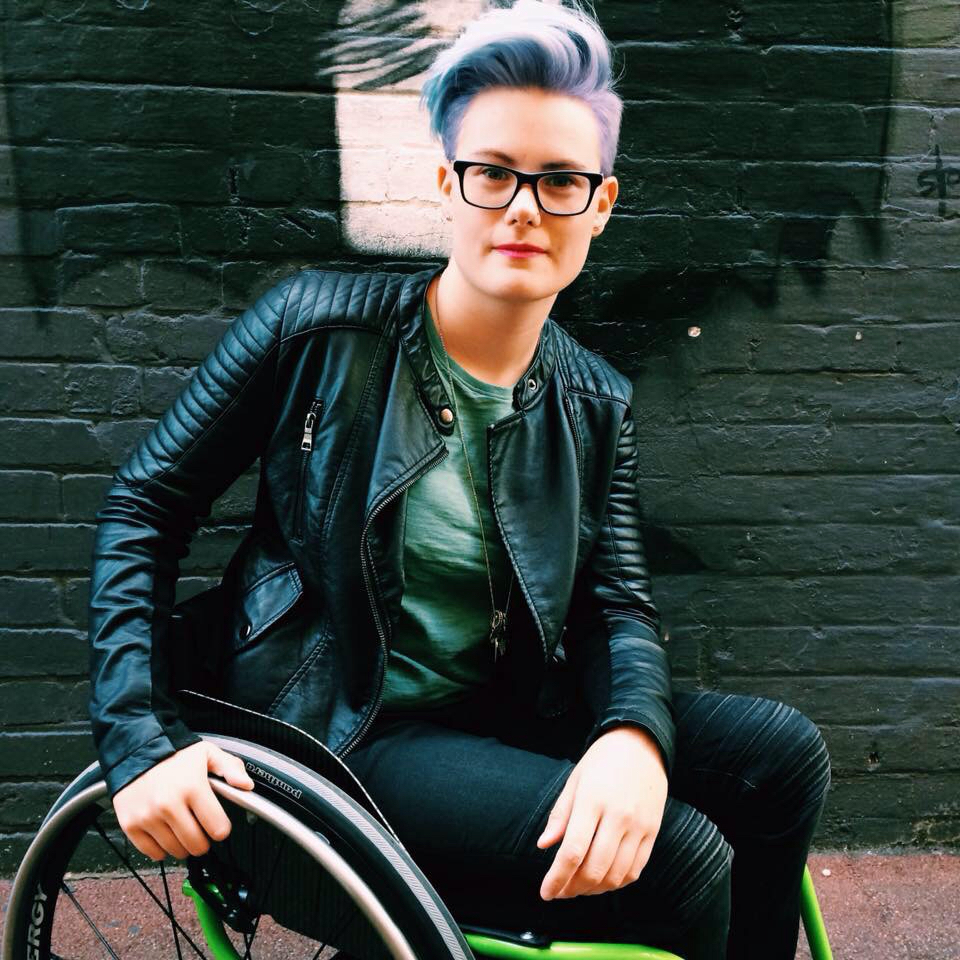
Robyn Lambird in a wheelchair
"I think it’s such a big deal because the of the lack of representation within our society mean role models for young people living with disabilities are scarce", Robyn says.

"As a person living with a disability myself, I know how validating it can be to see someone who has experienced similar struggles or who has shared a common identity."

Image descriptions:

Top picture: an infographic featuring diagonally placed images of Robyn Lambird and Madeline Stuart. Robyn wears pink cap, dark overalls over a print tee shirt, she's smiling and pointing to a Target catalogue. Maddie's photo is black and white, with pink highlight. She has long dark hair, with a black top hat, is smiling, and wearing a black and pink tutu. Black cursive text reads "Aussie models with disabilities rocking the fashion world."

Second picture: Target catalogue featuring two photos of Robyn Lambird. One is of her face and chest, she's smiling and wears a black tee shirt. The other features her in a purple singlet, black pants and she's in a green wheelchair. There's also an image of a non-disabled woman. Heading reads "New season active wear", outfit details and prices, and words from Robyn, quoted above.

Third picture: Julius and his mother Catia. He has brown hair and is making a duck face. She has long brown hair and is smiling widely, cuddling him.

Fourth picture: Madeline Stuart at 2014 New York Fashion Week. She's wearing a cream and metallic strapless gown with lots of peplum layers around the waist, frills on the bottom, and she wears silver face paint.

Fifth picture: Madeline Stuart wearing a black long sleeved top. She has long red hair and she's smiling. Text reads Speechless Vulgarity, and outlines NYFW details.

Sixth picture: Robyn Lambird sits in a wheelchair. She wears a black leather jacket, green top and black jeans. Her short hair is grey, pink and purple. She also has black glasses.

Did you like this post? Did it help you or make you think? Please consider buying me a drink!


LinkWithin

Related Posts with Thumbnails