You know when you have a crush on someone and somehow you magic your life so your worlds collide and you do something together? Well that hadn't happened to me until I was asked to be on the Just a Spoonful podcast with Kaitlyn Plyley earlier in the year. I had SUCH a giddy crush on this podcast. I remember listening to all of the previous episodes the week I discovered the podcast. I loved the interviews with chronically ill and disabled guests. And I love the theme song, which is often stuck in my head for hours after listening. But my biggest crush was on Kaitlyn's accent! (I now realise I'm on the verge of being one of those micro-aggressors who can't get past how amazing she sounds - but I swear I see Kaitlyn's big, creative brain too!) And so can you imagine my excitement when I got to talk to her on the podcast for real?!
Listen to the podcast here:
Unlike the miserable eventuation of many of my crushes, Kaitlyn and I became BFFs immediately when we started talking. I KNEW we would get along. She is so nice and funny and smart and accomplished. What I didn't know is she is as big a Savage Garden fan as I am. Friends, you're in for a treat.
We talk about the awful film Me Before You (I had not watched it yet) and the concept of Cripping up, oppression Olympics, the guilt I feel when I'm not able to work, and how hard it can be to prove ourselves because of our disability. And then there's a whole heap of NOT talking about disability, which I really like. Here's a quote:
"There's that pressure, you know, because I've been given an opportunity to work, been given a lot of opportunities, [that] I have to perform at 120%. I do most of my writing in bed, because I have to conserve that energy ... My priorities go, my skin and then my day job, because they have to."
I must warn you - not to put you off, because I hope you'll stick around - this podcast goes a little like this: Hello. Giggle. I GUSH OVER HER ACCENT. SHE GUSHES OVER MY DRESSES. More giggle. Disability talk. Giggle. Pop culture. Giggle giggle. OMG YOU DO LOOK LIKE JUSTIN BIEBER! Giggle giggle giggle. Disability talk. Serious stuff. Giggle. OMFG WHY DIDN'T WE TALK ABOUT SAVAGE GARDEN FOR THE WHOLE EPISODE?! I really mean that. Giggle. Savage Garden song.
Kaitlyn and I met IRL in Melbourne a few months after recording the podcast. She understands the need to bring a blanket to other people's houses because of likely coldness and soreness. We are yet to start our own Savage Garden Gigglers podcast, but that's a good idea, right?!
It's a year since #CrippingtheMighty happened. In short, The Mighty, a disability-focused site, publishes content that is damaging to people with disability. A number of disabled writers and activists spoke up on social media, and created a lot of content about the issues, offered advice to writers and editors, and a few of us (now former) writers were thrown out of The Mighty writers group - probably because we were too outspoken for them. I wrote about it here and here - and there are lots of others who did too. You can read a Storify of tweets and articles here.
The best thing to happen was that I met amazing, likeminded people - and I've gone on to write lots of articles this year - and been paid for them!
Despite the commentary around it, and a number of us trying to work with The Mighty, they continue not to pay writers, and continue to produce inspiration porn and divide the disability community. It's concerning to see The Mighty used as as resource to teach people about disability, and to connect people with disability. They are looking at changimg, though. However, I imagine most writers would prefer to be paid for each article rather than through a best performance system, or not at all, with forecasted revenue potentially going to not for profit. Just pay the writers.
In an email last week, Mike Porath, founder and CEO wrote:
As we complete our second full year of operation, I wanted to give you a brief update on The Mighty, ask for your thoughts on a key initiative, and encourage a few of you to take a larger role in our community. First, the update: Together with your help we are growing our community and helping so many more people. When we launched The Mighty in 2014, our stories were viewed 2,000 to 3,000 times a day. Now our stories are being viewed 2 million to 3 million times a day, including our videos. If you want insight into our operation, the effect our stories are having on people, how we are growing and where we’re going from here, please check out my post from a couple months ago. Second, a new initiative: to fund our growing operation, we will begin partnering with brands as sponsors and begin experimenting with different ways to drive revenue. Over the coming months, these experiments will only cover a small fraction of the costs to run the site, but they will help us determine the best ways to grow The Mighty into something that helps far more people in many more ways. As we enter into this new phase, we want to get your thoughts on ways we can contribute a portion of the revenue to the community. Here are just three possible examples: 1. Our plan from the beginning was to contribute a portion of our revenue to nonprofits that are working with The Mighty and our contributors. 2. A performance-based payment model for contributing writers. 3. An operation that helps companies (our future sponsors) hire more people with disabilities and other health conditions. Again, as we begin to bring in revenue (we’ve made no revenue up to date), any initiative we fund will be fairly small, but we have a very big vision of what The Mighty can become and expect there will be many ways for us to contribute to the community as we grow. Please take a few minutes to give us your opinions on this matter and others in this survey here. Third, an opportunity: Have you ever considered working for The Mighty? We are getting about 1,000 submissions a week from contributors, far more than our small team of editors can handle. We're hiring part-time editors in several of our sections. To find these people, we'd like to start with you: the people in our community who know us as both a site and brand, and the conditions we cover. We're thrilled at the idea of having some of you join our Mighty team. These positions can be remote and have flexible scheduling, but they will also require a great amount of training and eventually, fast editing with thoughtful ways to frame stories. To apply to take an edit test with us, fill out the application form here. We hope you'll consider applying, but we can only bring on a few paid positions right now, so please do not be discouraged if you are not initially selected. If you have any further questions about our hiring process, please reach out to community@themighty.com. We'd also like to encourage any college students to reach out to that email address if you are looking for an internship. We'd like to reiterate: we are so excited at the thought of you joining our Mighty team and grateful for what you've helped us create so far. We've truly done this together. Mike Porath Founder and CEO, The Mighty
The fabulous Alice Wong interviewed a number of us who took part in Cripping the Mighty - all former writers - and here's the result on Disability Visibility Project.
One thing I didn't say in my spiel, but wish I had, is that people who keep writing and sharing The Mighty posts are perpetuating the problem. It is not a site that supports disability rights. It doesn't pay writers. It doesn't respect advice from actually disabled people. It caters to the inspiration porn loving, medical model following, burdened parent. I have lost respect for writers who continue to write for The Mighty knowing the problems, and the feelings of many disabled people.
Since last December, The Mighty has categorised impairments. They have dedicated Facebook pages per impairment, and readers can search the site and view articles on the impairment they choose. I don't understand the divide by categorising impairments. So medical model focused. If you have cerebral palsy, why not learn about autism, or if you're a parent of a child with Down syndrome, why not read how the experiences across disability types can be similar.
It also takes advantage of writers who feel this is the best opportunity they can get. There are SO many more ways to get your voice heard. I've seen many disabled writers published in the mainstream - really making waves. I've been one of them, writing for the ABC and News.com.au this month. It's been a huge reach and a brilliant opportunity.
As I learnt from Cripping the Mighty, and in my other areas of work this year - there are hundreds of actually disabled media makers out there. We've come together to highlight important issues including the impacts of the US Presidential Election, assisted suicide, the murders of disabled people, and of course media representation. We mobilise on social media. And these are the issues The Mighty isn't covering.
There is no reason for our voices not to be centred in the media. Nothing about us without us.
It's an exciting week for disability-inclusive fashion - from chainstore to runway. Two young Australian women featuring in the Target catalogue and in New York Fashion Week.
This week, Target features a young woman with a disability in its catalogue. Robyn Lambird, who uses a wheelchair, models activewear. Above her smiling face, she's quoted: "As a para athlete, I practically live in activewear. That's why I love Target's range - it's got me covered for the who,e day. With plenty of options for working out, and fashionable pieces, that are perfect for busy days in between training sessions."
I chatted with Robyn, who has cerebral palsy, about how modelling for Target makes her feel.
"Oh man, it’s awesome! I’ve been talking about the importance of having more adequate media representation for a while now, so to play apart in that is really cool. For me it’s all about normalising disability, I want to get to a point where it’s commonplace to see people using mobility devices, or with missing limbs, and a whole range of other conditions in our advertising."
Robyn hopes her appearance in the Target catalogue leads to standard inclusion of disabled models.
"We need to get to a point where including disabled models in advertising is standard", she says. She believes companies that pride them on diversity need to reflect that, through representing all types of people - including people with disabilities. Robyn believes representation in advertising will help increase disability's cool factor.
"As a society we also need to change the way we look at disability - a lot of people write the disabled community off straight away as not being trendy or cool. I know models for instance who can’t get casting agents and have been told by them that 'disability isn’t their look'", Robyn laments.
Catia Malaquias , mother to seven year old Julius who has Down syndrome, campaigns for inclusive advertising through Starting with Julius. She agrees with Robyn's take on inclusion changing perceptions of disability.
"Advertising in particular can be extremely powerful as a medium. Ads are pervasive and far reaching – we see ads on our social media, favourite blog, a web page, before a movie or during our favourite TV show – and they are designed to impact our perception of the world around us. For the most part they represent a world without disability and with minimal human diversity and that both reflects and reinforces social exclusion and devaluation of "difference". Inclusive advertising seeks to disrupt that."
Target has regularly featured children with disabilities, but Robyn (and I) would like to see more adults with disabilities included in Target's catalogues.
"It’s kind of crazy to think that 1 in 5 people will experience disability in their lifetime, yet as far as I’m aware I am the first adult with a visible disability to feature in a nationwide advertising campaign of major retail company in Australia. If people don’t see individuals with a range of disabilities in our media, it’s easy for stereotypes to form and for misconceptions to thrive", Robyn says.
Therese Waters from Target's Corporate Affairs team assured me it's not the first time a disabled model has featured in Target's catalogues. "In the 1990’s we featured a model in a wheelchair", she says.
Therese said it's important for Target to reflect Australia's diverse society. "One in five people in Australia have a disability so that needs to be portrayed in our marketing materials", she says.
She told me she hopes that through Target's diverse advertising campaigns, perceptions about people with disabilities are shifted.
The inclusion of disabled in advertising campaigns makes both models and the wider disability community feel valued and represented. "It’s important that our customers know we’re all about making people feel confident about themselves. Our uniqueness should be embraced", Therese says.
While inclusion in fashion advertising is a great start, Robyn also believes the fashion industry needs to make clothes more accessible for people with disabilities.
"There are a few brands out there that design for disabled people and wheelchair users, that I really admire but I’d love to see a little more diversity. I’d really like to see more options for disabled teens and young adults as a lot of accessible clothing is aimed either at children or older people . I love bright colours and wacky prints so if I ever got into designing I’d be sure to incorporate that.
"For me as a wheelchair user it all comes down to how things look when I’m seated, things don’t always fit as nice in the chair. I also find buttons and things like that a little tricky because the dexterity in my hands isn't so great, so that’s always something to consider", she says.
She hopes to model for Zara and G-Star Raw - and I'm sure she will be noticed by those brands and more. She continues to make opportunities happen by telling her story, not through fashion but words - using her blog and Youtube channel () to change people's perceptions of disability.
Robyn isn't the only Australian to rock the fashion world this week.
On Saturday, Madeline Stuart will be modelling in New York Fashion Week. Nineteen year old Madeline has Down syndrome and has been modeling since 2014. She told her Mum Rosanne that she wanted to become a model after attending a fashion show, and after posting professional photos on a public Facebook page, her career took off quickly.
This is her third time at the New York event - perhaps the most high profile of the fashion calendar.
This fashion week, Madeline will model androgynous label Speechless Vulgarity - their clothes are designed to promote self confidence. The label's motto is "Be dope be love be you", which symbolises Madeline's self confidence.
With the help of her mother, Madeline told me what she enjoys about being a model. She loves meeting fantastic people and travelling the world. But it's hard work too, she says. The hours are long and she's on the road all the time. She has some frank advice for other people with disabilities who want to get into the modeling industry.
"If you want to be in the modelling industry you need to be really fit as it is very hard work and very long days. Plus you need to have really good self-esteem as it can be very critical."
The long hours and time away from home is worth it though, for the rush of New York Fashion Week. "I love it, it is my favourite activity, to be there with all the excitement is nothing short of amazing", she told me.
Catia Malaquias believes Madeline's success as a model is valuable for people with Down syndrome and their families, as well as wider society.
"Every time that a person with Down syndrome has the opportunity to participate in public life, they are challenging in a very visible way the cultural exclusion of people with Down syndrome", Catia says.
She believes that the most effective and inclusive representation of people with disabilities in fashion and advertising is featuring us with non-disabled people.
"In many ways, the most effective advertising simply represents people with disability incidentally alongside non-disabled people, as part of our society’s diversity."
However, like me, Catia believes disabled people should be consulted about the way we are represented.
"Fundamentally, people with disability should be represented authentically and the best way to ensure this is for there to be dialogue with people with disability about how they would like to be represented."
Madeline Stuart realises the importance of her work, too.
"I think it is important that everyone is represented in the public eye so when I walk I hope I am showing the world we are all equal. I am so happy to be walking at New York Fashion Week for the third event in a row. I feel that I am now a regular and have made a great change in our industry", Madeline says.
In the week that her own modeling career takes off, Robyn Lambird, also 19, is grateful to see Madeline Stuart walk the runway on the other side of the world. She told me Madeline's inclusion at New York Fashion Week shows other young people with Down syndrome that it's possible to pursue their dreams.
"I think it’s such a big deal because the of the lack of representation within our society mean role models for young people living with disabilities are scarce", Robyn says.
"As a person living with a disability myself, I know how validating it can be to see someone who has experienced similar struggles or who has shared a common identity."
Image descriptions:
Top picture: an infographic featuring diagonally placed images of Robyn Lambird and Madeline Stuart. Robyn wears pink cap, dark overalls over a print tee shirt, she's smiling and pointing to a Target catalogue. Maddie's photo is black and white, with pink highlight. She has long dark hair, with a black top hat, is smiling, and wearing a black and pink tutu. Black cursive text reads "Aussie models with disabilities rocking the fashion world."
Second picture: Target catalogue featuring two photos of Robyn Lambird. One is of her face and chest, she's smiling and wears a black tee shirt. The other features her in a purple singlet, black pants and she's in a green wheelchair. There's also an image of a non-disabled woman. Heading reads "New season active wear", outfit details and prices, and words from Robyn, quoted above.
Third picture: Julius and his mother Catia. He has brown hair and is making a duck face. She has long brown hair and is smiling widely, cuddling him.
Fourth picture: Madeline Stuart at 2014 New York Fashion Week. She's wearing a cream and metallic strapless gown with lots of peplum layers around the waist, frills on the bottom, and she wears silver face paint.
Fifth picture: Madeline Stuart wearing a black long sleeved top. She has long red hair and she's smiling. Text reads Speechless Vulgarity, and outlines NYFW details.
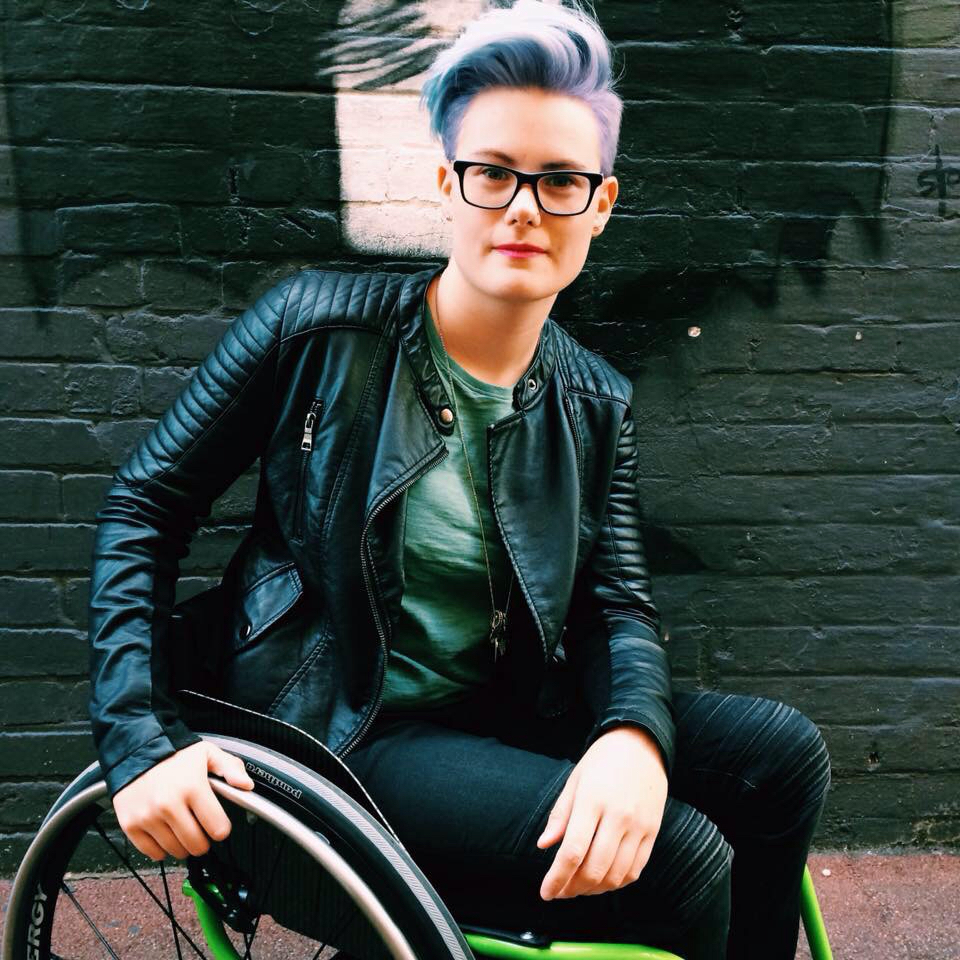
Sixth picture: Robyn Lambird sits in a wheelchair. She wears a black leather jacket, green top and black jeans. Her short hair is grey, pink and purple. She also has black glasses.
"When she was born, she looked like an alien. It was very traumatic"
"Her bizarre condition."
Those three excerpts is all I took from the article, and I am someone with Ichthyosis.
The language used in this article about a beautiful baby with Harlequin Ichthyosis is so othering, pitying, sensationalised and disempowering it's no wonder some people with the condition question their self worth, and people without the condition are shocked by it.
I was so saddened at this language to describe one of my people that I didn't take away that she is loved, that she is oh-so-cute and that she will most likely have a good life with the right medical care and emotional support.
What are readers who *aren't* affected by Ichthyosis getting from the story?
This language gives readers permission to be shocked by Ichthyosis. It perpetuates the idea that we are objects to be gazed at, that the condition is shocking and
Awareness raising through tabloid media. Stripping dignity from people with Ichthyosis every day.
I asked Harper's mum Angie and grandmother Charlotte what they thought of the news story, and what they'd like the world to know about Harper, given the reporter missed so many details about Harper's personality and beauty.
Charlotte said:
"I thought the article, except for a few mistakes, was pretty true on. I wish they had elaborated more on what is Ichthyosis, what causes it and that there is NOT a cure. I want people to understand that this condition is not "contagious", that these children (and adults) can have full lives. They are not a "freak" show, they are humans with real feelings; real challenges; real needs, just like everyone else! I realize that Harper will look "different" but that "different" makes her UNIQUE. She is a beautiful, loving child who will grow up surrounded by love. She will go to school and learn just like every other child. I think that but getting the correct information out, people LEARN about the condition and the challenges. I know, for my own self, I have been forever changed because of Harper. This change is a GOOD thing! People are curious when someone looks different and that is why educating people is so darn important!"
Charlotte continued:
"I think Harper is simply adorable and when she smiles at you, it warms your heart! I walked in the house the other day to pick up the two older children to take them to the movies, and Harper was sitting in her highchair munching out on banana. She saw me, smiled and then growled at me. I growled back and she got this smile on her face and giggled. It was so cute! She just melts me!"
Angie, pictured with Harper above, told me:
"Harper loves eating, her new favorite are bananas that she feeds to herself. She loves when you sing & dance with her. She is the biggest Mama's girl ever. She will be dead asleep and hear my voice and wake up and start kicking & squealing like crazy. I ❤️ it!! If she had it her way, I would just carry her all day. She's trying to talk and ends up growling. Lol. She loves playing with her sister, Sam who is 17 & brother Jaxon who is 6. She loves cuddling with her Daddy at nighttime. Harper also just learned to shake her head no, it's so cute. She brings so much joy to our family and we are so blessed by her beautiful soul."
I was disappointed to read yet another sensationalist article about a child with Ichthyosis. But I'm very glad to get to know more about little Harper through those who love her. I really do wish the media would focus on showing people with rare medical conditions in a more positive, holistic and less pitying light. We are not here for clickbait, exploitation and sensation.
Courtney Westlake wrote a brilliant piece about the gawkers that Brenna encounters this week, and I think her response to "Look at her" applies to this article about Harper too.
Just look at how beautiful she is and what a wonderful life she has ahead of her. And look at how those who love her have written about her. There's optimism and appreciation and a real sense that she's a whole person, not "horrible Harlequin Ichthyosis". Her mum and grandmother's words will make a stranger more 'comfortable' about this rare, often confronting condition than the tabloid article I've pictured above ever will.
Language really does matter when reporting about people living with Ichthyosis.
Late last year I met a wonderful woman called Jenny Joy, and she interviewed me for her Fully Sick podcast. The episode aired last month - apologies for not posting about it earlier.
Jenny is such a great conversationalist. I really opened up in our chat - to the point that this needs a content warning about suicidal thoughts. If you need to talk to someone, please contact Lifeline on 13 11 14 or Kids Helpline on 1800 55 1800, or the crisis line in your country.
Jenny has chatted to some amazing people - all living with chronic illnesses and/or disabilities. Her podcast is funny, interesting, deep and useful. Give all of the episodes a listen. How great to see people with disabilities making their own media!
The hands-down best thing about the Internet is how it's allowed so many of us (especially from marginalised communities) to have a voice. We can all be media makers and have an audience. And the first-person perspective is so valuable - and increasingly more prevalent. Five years ago, it was other people telling out stories. And now we are doing it for ourselves.
These podcasts are all hosted by writers who have disabilities, chronic illnesses and mental illnesses. I especially like these podcasts because they discuss broader issues around disability, chronic illness and mental health - issues sometimes difficult to acknowledge individually when we are wrapped up in the day to day of coping, and sometimes hard to discuss with others affected by our conditions.
Disclaimer: I'm soon to be featured on three of these podcasts. I'll let you know when my episodes are up.
Please also note that none of these podcasts apart from The Accessible Stall and In Sickness + In Health have transcripts.
Fully Sick - hosted by Jenny O'Keefe
Jenny is an Australian writer, radio presenter and marriage celebrant. In the middle of last year Jenny got in touch with me, recommending a hairdresser for my wedding (who I contacted and contracted - and she made my hair fabulous!). Later in the year, Jenny wrote to me again to tell me about her planned podcast and invited me to be interviewed. Of course, I said!
Jenny has fibromyalgia and spent all of episode one talking about her experiences with her wife Tracey. She is upbeat and is incredibly giving with her story.
Jenny interviews a different person with a chronic illness or disability in each episode. The guests have shared so much about themselves and I've learnt (and empathised) a lot.
She's three episodes in, and I'm enjoying it very much. She's got a great rapport with guests, and she's funny! I really like the medical and psychological perspectives from two professionals, too.
The Anxiety Shut-In Hour - hosted by Anna Spargo Ryan and Erin Van Crimpen
Anna and Erin talk about anxiety, depression and suicide on the Anxiety Shut-In Hour. I've listened to a few episodes, and I've learnt a lot about mental health.
The women are articulate - speaking about themselves, current issues and offer useful advice for people living with mental illness.
I am in a wonderfully supportive writers group on Facebook and one day I saw a post by Kaitlyn Plyley, an Australian writer and performer. She wrote of a massive achievement for her podcast - interviewing Jill Pantozzi, a US journalist. I asked Kaitlyn where I can find her podcast, and she posted the link to her website. I immediately downloaded all the episodes and have been listening to one episode a week.
And I love it! I love the long form conversations she has with her guests. Like with Fully Sick, each guest has given so much of themselves. Much of the discussions are wider than chronic illness - Kaitlyn and her guests chat about all sorts of things including career, pop culture, fashion and life in general. I loved the chat with Amy Dallas - a young woman who is so incredibly accomplished and driven.
The theme song is pretty, and I often find myself humming to it, even when I'm not listening to the podcast.
When Kaitlyn interviewed me for the podcast, we giggled so much. Gosh it was fun! She looks a bit like Justin Bieber, and we both love Darren Hayes. She's just moved to my city and I cannot wait to meet her in person. I told her I have a crush on her accent.
Stella Young first told me about BBC Ouch when she was launching ABC Ramp Up. It's a UK radio program hosted by UK journalists with disabilities.
The hosts cover issues around accessibility, disability politics, British politics, media, arts, identity plus more, and interview guests with disabilities.
I love that this puts disability in the mainstream.
The Accessible Stall Podcast - hosted by Emily Ladau and Kyle Khachadurian
Emily Ladau is one of my favourite writers and disability activists, and so I was excited to see she has recently released a podcast with her co-host Kyle. Fangirling!
The hosts don't always agree on everything, and this is the beauty of listening to them. The episode about identity is a great example of this. Emily sees disability as part of her identity "just as much as being Jewish and being female - a large aspect of what makes me who I am", she said. But Kyle doesn't feel the same. He acknowledges his disability, but it "means as much to me as being a male or brown-eyed - it doesn't really have any intrinsic value", he said. "It doesn't play into the person I am, though I give it credit for playing into the person I became. It's just there."
They've also made me think about things differently - since listening to the episode about the pre-cut fruit, it's made me consider what's worth speaking up about. It can be easy to het outraged about a seemingly little issue, especially when it's a collective effort, but that means it can also detract our energy from advocating for/against bigger issues.
I think I came across In Sickness + In Health when the podcast Twitter account retweeted a tweet of mine. I clicked through to their account and saw it was a podcast! Hurrah! I downloaded most of the episodes and have listened to each when I've had a long task to do.
Similar to Just a Spoonful and Fully Sick, IS+IH features a chats with different guests with varied conditions. The conversations are in depth feature perspectives from different countries.
Even though the podcast has only been broadcasting since October 2015, there is a big back catalogue of episodes. There are often bonus episodes - I love this because often at the end of a podcast, I want to hear more from the guests.
The disclaimer at the start of each episode is wonderful - do not recommend any treatment to the guests, no matter how well meaning you are!
I had a long chat with Cara and it was really fun! She asked me a lot about the Australian healthcare experience, and she was interested to learn how much it differs from America.
I am so excited about these podcasts. They really are great listens that feature interesting people, and I've come to make some genuine friends with some of the hosts. Do give them a listen.
How to listen to podcasts:
Some podcasts can be downloaded (saved and/or streamed) from program websites. Many are linked to radio programs and can be streamed through their websites.
You can also download podcasts through apps on your computer, tablet or phone. I listen to mine on my iPad and iPhone. You can download through iTunes (this is how I listen to them) or other apps such as Stitcher. A list of 10 great podcasting apps for many operating systems can be found at Tom's Guide.
I listen to podcasts on iTunes, and have linked to the iTunes podcast stream for each podcast here. But I've also included the websites for all of the podcasts in this blog, so click on the links for more listening options.
What chronic illness, disability and mental health podcasts do you recommend?
This post discusses suicide. If you need to talk to someone, please call Lifeline on 13 11 14, or QLife 3pm-12am on 1800 184 527, or the equivalent support service in your country. It also contains spoilers about the book and the film Me Before You.
Me Before You is released in Australian cinemas today. I saw the film last night (at a special 'girls' night out'), and have read the book. (Yawn!) However, I had formed an opinion about the film before I had seen it, based on others’ valid commentary, and my own experiences and insight into disability themed and led media.
Me Before You, based on JoJo Moyes’ 2012 novel, is the story of the relationship between Louisa Clark (played by Emilia Clarke) and Will Traynor (Sam Claflin). Louisa takes a job caring for Will – who became a quadriplegic due to a pedestrian accident. Will was a high flying money maker, and gave that up since the accident. He wants to end his life in six months, and Louisa tries to show him that life is worth living.
Louisa is perky and quirky, saying mildly humourous things that I found ironic when juxtapositioned next to disability. "There isn't much that can't be solved by a cup of tea", she told Will early on. Well, how about attitudes towards disability? Employment rates? Accessibility? Internalised ableism?
The film has been marketed as a romantic tear jerker. As my friend, Kaitylyn Plyley, podcaster extraordinaire said, "Girls night out. Watch a disabled man die. I don’t know what these cinema marketers think girls do on nights out." My film-buddy Kath (who giggle snorted throughout the screening) called it a "woe-mance". Also, in one scene, Joanna Lumley's character said "one can't do these things sober", and I wished I had a drink to help me through.
The main message the film conveys that death is a better option than living with a disability. Will ends his life because he has a disability. That's the only reason. He cannot live differently to the way he lived prior to his accident. He has the wealth and support to live a comfortable life - which many people with disabilities don't have.
The film highlighted the expectation of a non-disabled person to be a hero, to save the disabled. Louisa took care of Will and she learnt a lesson. She told him that. She needs him to be a better person. Disabled people are not your teaching moments.
There is also the issue of a non-disabled actor cripping up, the portrayal of disability as a tragedy, and the way our response has been shushed by non-disabled people.
There's not much to say about Me Before You that hasn't been said by my fellow disability activists already. For one of the first times that I've known, the collective voice of the disabled community has been hear loudly. As Buzzfeed headlined, The "Me Before You" Backlash Was Bigger Than Anyone Expected.
Twelve year old Ella Frech wrote an open letter exploring themes beyond her years, asking "Dear Hollywood, Why do you want me dead? Please don’t deny it. The movies you make tell me the truth about what you really think about me.".
There are also the brilliant Huffington Post and Karolyn Gehrig articles, from which I’ve quoted towards the end of this piece.
And the Center for Disability Rights in New York created a video showing just how many films feature the same narrative that death is better than disability, and assuring disabled people their lives are worth living. The disability-led commentary has been amazing.
Despite our loud voices, there's still shushing from the non-disabled, telling us what the film is about, and how we should feel about the film.
The film's director, Thea Sharrock, believes the activists anger is a "misunderstanding".
Writer, JoJo Moyes (who also wrote the screenplay) said you can’t judge a character "unless you put yourself in somebody’s shoes". Many disabled people are in Will Traynor's shoes, JoJo.
Actor, Sam Claflin didn’t even want to engage with the disability activists during his chat on Twitter, ending the chat early.
And the online commenters - ablesplainers - are telling us to get over it. It’s just a film!
When I first wrote about the film on my Facebook, and shared links to others’ writing, I was told that I had to watch the film to make a proper judgment. My lived disability and media experience didn't count. I was told that it wasn’t REALLY about death being a better fate than a disabled life, and disability hasn’t been portrayed as a tragedy – Will was just an arsehole. So much ablesplaining.
Oh, but it's just a book and a film. Relax, it's fiction. So, what’s the problem?
Popular culture has a huge impact on the way disability is perceived. And in this case, the book and film has portrayed disability as a tragedy. Many readers and viewers will get their perspective of disability from this book and film, yet won't even interact with an actually disabled person. They won’t see that a person with a disability can have a joyous, pride-filled life.
Readers and movie goers are crying over Will Traynor's death, yet are they crying over the barriers and discrimination actually disabled people face in our everyday lives? Do they know about the low employment rate and poverty experienced by so many, and what are they doing to change that? How are they changing their low expectations of people with disabilities if they regard Louisa as a hero for caring for Will? (I am amused that art imitates life, and Louisa has zero qualifications to care for Will.)
(Just on low expectations, I've been thoroughly researching what people have said about the film. I listened to a podcast that reviewed it, and one of the hosts thought the portrayal of Will was unrealistic because of his disability. He was too attractive for a man with a disability, she implied. She went there.)
I'm concerned the only exposure to disability people will have is through a schmaltzy, fictional depiction of us. They see 'us' through the movies, and they cry. And they laugh at our disabled quirks. They see us in real life and they pity us, or other us, and never get to know that our lives are worth living. Are they even getting to know people with disabilities away from popular culture? The able gaze is narrow. People are fascinated by how we move, eat, think, have sex, and can be loved, and they look away quickly. It's easier for readers and viewers to get to know disabled people from the comfort of seeing us through fictional characters, feeling like they’ve learnt something about disability just by consuming Me Before You.
While watching the film, I paid attention to the audience's reactions. The audience laughed at the severity of Will's disability symptoms - like spasms and voice, and any scenes that hinted at love and sex. Was that funny for them? Awkward? A bit gross? Can a disabled person even have sex or be found attractive?! (That question was evidently on people's minds from the laughter I heard.)
The saddest thing for me during the film was hearing the audience laugh at how inaccessible the race track was for Will's wheelchair. It sunk into the muddy grass and he looked frustrated. Help was called. This inaccessibility is every day for disabled people. And the audience laughed.
The laughing able gaze was sickening while watching the film last night. There was more laughter than crying - perhaps the audience didn't see disability as a tragedy, just an awkward thing to laugh at? As I live-tweeted the film, my Twitter followers told me they were disturbed at the audience's laughter, too.
Nothing I do transcends disability. It is deeply entrenched in every thought, action, and interaction. To deny its inextricable nature is to dismiss, shirk access, make the world more unforgiving for me, and those in my community. Especially those who do not yet identify as members of the disability community, out of fear or self loathing. Those who might "want to see Paris, but as me." You do your companions no favors by rendering disability so flat."
I do wonder if all those people who support the tragic narrative of disability and cripping up by non disabled actors would go see theatre, films, music and art made by actually disabled people? Would they see our take on disability, or prefer Hollywood and airport bookstore schmaltz?
Another issue is Sam Claflin cripping up (a non-disabled actor playing a disabled person). Ablesplainers say "BUT IT'S ACTING. THEYRE PLAYING A CHARACTER. THEY ARE PRETENDING TO BE DISABLED."
The role could have gone to an actually disabled actor. Most likely he will win some sort of award for being a hero and playing a disabled character. As Scott Jordan Harris wrote:
"Able-bodied actors should not play disabled characters. That they so often do should be a scandal. But it is not a scandal because we do not grant people with disabilities the same right to self-representation onscreen that we demand for members of other groups who struggle for social equality" .
There are so many disabled artists who could play have played the role of Will Traynor. Blacking up is not acceptable in film and wider society, so why is cripping up?
I also want to acknowledge that not everyone feels the same way about the film as myself and other disabled activists, especially around the theme of assisted suicide. As Holly Warland wrote in her very articulate piece on DailyLife:
"I see the character's decision to end his life on his own terms empowering. I'm in a very unpopular section of disabled society who believes in the right to assisted suicide for those competent enough to make the decision for themselves. For full disclosure, I will reveal that as a 24-year-old woman with Muscular Dystrophy (this involves the deterioration of my muscles from the chin down over time and means that I rely on 24-hour care), I plan on taking my own life once my disability causes me more grief and anguish than I feel is worth living for."
It’s a very complex issue, and I respect all views. If it comes to the time when my skin is too painful to bear and my quality of life is reduced considerably, I hope I have the choice of voluntary euthanasia. However, like Jax, I do worry that the message of this film might prey on vulnerable people with disabilities, it might make them think they are better off dead.
I don't have an acquired disability, and I don't have the type of disability Will Traynor has. The physical barriers he and so many of my friends encounter are not my experience. But I do have a disability, and experience the same attitudinal barriers he and my friends experience. I've also experienced that internal ableism he feels - for a long time disabled was the last thing I wanted to identify as. There was a time when I was young that I wanted to die, life was so isolating. And I've had people tell me if they'd were me, they'd kill themselves. This has happened a few times.
I was on a date once. He was nice - academic, good at making conversation and funny. I was gazing at the way his hair flopped over his forehead when he told me if he looked like me, and had my skin condition, he'd top himself. He couldn't handle me publicly telling my story, he wasn't comfortable with me being proud. And he thought my life was so hard it was easier not to exist. This hit home how others see us, how Hollywood sees us. Lives not worth living. And I don’t want that to be the message that keeps on being perpetuated.
Many people within the disability community are angry about the book and film. But we’re also angry about how we’re being told to feel about the film. It’s the same old case of being grateful disability is even covered, of having our feelings and life experience invalidated. Mik Scarlet so eloquently wrote for the Huffington Post:
" Throughout the comments sections of blogs and articles explaining disabled people’s views are non-disabled people telling us we’re wrong. Not just about the film but pretty much whatever we’ve said. Our real life experience is nothing compared to stereotypes and beliefs of those who can only imagine how they might cope with impairment. Hence a debate around a work of fiction has become something bigger. To me it has now opened the lid on the truth behind how society sees disabled people. The key message from the recent protest around Me Before You is disabled people should just be happy that good intentioned people are trying to do something for us, with no experience of what it means to be us, and without really talking to us. We are not allowed to be experts in what our lives are like, or what we want? The mantra of all campaigners for disabled people’s equality is "nothing about us, without us" yet this whole furore has proved how far we have to go to achieve this goal."
One of the most poignant passages of the book for me was the part following a day out of the races - tiring from inaccessibility and staring. It particularly resonated with me because of so much of the shushing that's gone on towards the disability community. It is such a true example of people speaking for us, over us. Perhaps JoJo Moyes had a premonition that we, too, didn't want someone else telling us how our lives should be run.
" ‘Is … something the matter?’ I said, when he failed to respond to my third comment about the local news.
‘You tell me, Clark.’
‘What?’
‘Well, you know everything else there is to know about me. You tell me.’
I stared at him. ‘I’m sorry,’ I said, finally. ‘I know today didn’t turn out quite like I planned. But it was just meant to be a nice outing. I actually thought you’d enjoy it.
I didn’t add that he was being determinedly grumpy, that he had no idea what I had gone through just to get him to try to enjoy himself, that he hadn’t even tried to have a good time. I didn’t tell him that if he’d let me buy the stupid badges we might have had a nice lunch and all the other stuff might have been forgotten
‘That’s my point.’
‘What?’
‘Oh, you’re no different from the rest of them.’
‘What does that mean?'
‘If you’d bothered to ask me, Clark. If you’d bothered to consult me just once about this so-called fun outing of ours, I could have told you. I hate horses, and horse racing. Always have. But you didn’t bother to ask me. You decided what you thought you’d like me to do, and you went ahead and did it. You did what everyone else did. You decided for me.’
I swallowed.
‘I didn’t mean to –’
‘But you did.'
He turned his chair away from me and, after a couple more minutes of silence, I realized I had been dismissed."
So relevant, hey? (The movie left the race scene in, but skipped Will's assertion that he preferred not to have someone else decide what he wanted - I thought this omission weakened the film, implying others did decide what Will wants without asking. Of course, he was adamant that someone else didn't decide he should live on, live boldly.)
Will chose to die when he seemed most content. Loved by Louisa, surrounded by family. That's his choice, although it contradicted the so 2016 hashtag for the film - #LiveBoldly. But it was his informed, consenting choice, a complex one that was far too deep for a PG rating. The film ends with dead Will 'reading' Louisa a letter as she's in Paris (living the life he yearned for). "Live well" he told her. Yet Will didn't take his own advice.
There do need to be more films made about disability. But we need to be consulted in the creative process too. For us, this fictitious story is more than just a film we should get over. It’s a reflection of the low value and expectations society has for us.
There are people with disabilities who are not happy with their lives, and this is a valid, complex reality - I don't want to dismiss their feelings and decisions. But tragedy is not the only story about us. Disability should be an incidental part of a character’s life. Film makers need to show that for many people, disability is a proud part of our identity. We belong to a strong community. And our lives are worth living. Pride is a story.
Live well. Even with a disability. Because you can.
We are protesting Me Before You in Melbourne tonight. Come along to the Jam Factory from 6.00 pm if you're interested. Details on Facebook.
"You might have seen the one, the little girl with no hands drawing a picture with a pencil held in her mouth. You might have seen a child running on carbon fiber prosthetic legs. And these images, there are lots of them out there, they are what we call inspiration porn. (Laughter) And I use the term porn deliberately, because they objectify one group of people for the benefit of another group of people. So in this case, we're objectifying disabled people for the benefit of nondisabled people. The purpose of these images is to inspire you, to motivate you, so that we can look at them and think, "Well, however bad my life is, it could be worse. I could be that person."
I'm releasing an unofficial biography. All the cool crips are doing it. The art proof came in on the weekend. I'm loving the Vogue Magazine quote - clearly they're scouring my instagram.
I will sign each book with a greasy thumb print. Every copy comes with a limited edition skin flake. You can use it as a bookmark.
Look!
I'm looking like I am praying, wearing angel wings. Also wearing a cherry print blue dress, and pearls.
The text says:
Carly Findlay - #FashionAngel
"Inspirational."
Descaling the beauty ideal, one natural facial peel at a time.
Read how she's overcome an unfortunate facial affliction to succeed as #FashionAngel, brushing skin flakes off black silk.
"Carly's ability to choose fabrics that don't make her look like a greasy fish and chip wrapper is astounding." ~ Vogue Magazine.
That's a parody. Not a real book. I had so much fun helping to create it though. And I hoped that while it makes people laugh, it also makes them think.
Life's great when you can laugh at yourself and parody the way disability is represented in the media.
Imagine being the victim or hero of the story. Being told you're an inspiration for just existing. Or worse, being described a burden. (Being described a burden in your parent's book about raising you. The horror.) Imagine the constant expectation to overcome your disability. Your vulnerable image used as a sales tool. What about being so locked into a stereotype that people pity you, have low expectations of your abilities and commend you for getting out of bed. What if your closest relative was writing a book in your voice, to make an income? This is the reality for many people with disabilities.
Some friends and I created parodies of our biographies - dripping in inspiration porn, shocking with innuendo and comical blurbs. One featured two dildos. I hope it's jarringly obvious just how bad inspiration porn looks. I wrote my blurb with glee. Late at night, as the fake covers came through, I was giggling so much Adam sleep-slapped me to be quiet.
The reactions to us posting them on Facebook were interesting. Many of my friends realised it was a joke. Some congratulated me. But my disabled friends experienced the funniest and alarming reactions.
Their friends and family believed them. Requested copies of the book. Some didn't believe they could write and so were surprised at this fake announcement. Many were Inspired.
One friend told me how bemused they were, seeing their friends' reaction to the 'book':
"I'm abso-freaking-lutely hornswaggled.
How come Carly"s friends know IT'S A JOKE AND ALL OF MINE ARE CONGRATULATING ME?
I'm a little shocked that my friends think that I would happily promote the schlock I'm spoofing! Or they didn't read it... but even my pic is deliberately a shocker - how could anyone think that was a serious bio? And yet they did by the droves. Perhaps we are perceived as so desperate for attention that we would write anything, publish anything? Bizarre.
I can't wait for a book launch. All cover and no content."
That sums up the way some perceive our activism really. All cover, no content. Are they really even listening?
It's funny, my friends pointed out that so many readers of The Age article commented on my dress, overlooking what I had to say on inspiration porn. And they playfully named me fashion angel. Now I love fashion, and it's nice to be complimented, but perhaps I need to dress down to get the message across.
No matter how much we talk about disability, and what activism we do, some people will not know we do it, or understand it. They might not even want to. Addressing the reality of disability - especially calling out ableism - makes people uncomfortable. They've told me. They've told me to tone it down. To stop taking myself so seriously. Stop looking to be outraged. They're worried their casual ableism might offend me.
In my time writing about The Mighty, I learnt I could try to educate as many people as I could about the definition and problems of inspiration porn, and about disability pride, but the majority were blinded to it because of their perceptions of disability. One woman even told me disabled people exist to inspire others. They see what they want to see - their own perception of disability. And perhaps that's the case because of the churn of media that makes non disabled people feel good about themselves - seeing disabled people suffer, overcome amd inspire.
You could substitute a book with a film or newspaper article or tabloid magazine spread. People with disabilities are mainly portrayed in the same way, as I've highlighted above. Our voices are often diluted by others'. And that's why it's important to take back how we are portrayed. Own it. Laugh at it. Make our own media, on our own terms. Be firm with publishers and journalists about how we are portrayed - question their intent when approached. And we can be proud of and declare our real achievements - when we actually do amazing things .
I do want to wrote a book one day, but I want to do so on my own terms. I want it to be in the style of my blog. In my voice. My cover won't have a sob-story tagline. I will not perpetuate the demeaning, stereotypical way people with disabilities are portrayed.
I'm making an Inspiration Porn Resolution - the only way I'll perpetuate it is to parody it. I hope this demonstrates that we can speak up about the things that matter, while still having fun.
Since then, the editors have continued to ask for our feedback and said they'll take it on board. A number of us have provided advice on accessibility, payment for writers, language and content to both the site's editors and writers. The atmosphere in their dedicated Facebook writers group got very nasty, and on Friday afternoon (which was Thursday night/midnight US time), many of us (People with disabilities and those without) were removed from the group - with no warning and a very poor explanation following our removal. I was removed a few minutes after I called out the bullying of another writer. His actual words: "I thought you were able-bodied and just acting like you were disabled."
Their reason for our removal: "to return Mighty Voices to what it was designed to be. For this reason, we are removing anyone who hasn't submitted a story for consideration on The Mighty in the last four months." Interesting timing, hey?! They handled that well.
I've considered not blogging about this, but I maintain that it's really important we discuss how people with disability are included and represented in the media - to show who's doing it right and also who gets it wrong. (To help get it right. Alice Wong, Elizabeth Jackson and R Larkin Taylor-Parker have developed an excellent pledge for media outlets and writers to eliminate inspiration porn.) As Cara Leibowitz said today, the fallout from The Mighty and some of its writers makes me "sorry that actual disabled people had the nerve to critique a disability-related site." It's been a mighty mess.
Here is my feedback to the editors - I sent them this email.
Hello Vicki and team,
Thank you for your email advising me of removal from The Mighty Voices group. I am both amused and upset.
Your reasoning for our removal seems suspicious. Calculated even. It seems like you’ve removed the ‘problem children’, shaping the Mighty into a twee, parent-centred community, sourcing unpaid, oversharing, demeaning and feel-good stories about disability.
Four months since we’ve contributed is such an arbitrary figure. And is discriminatory to those who take a long time to write because of their disability.
You removed many people at midnight your time. Midnight. Who makes a decision to do that in the middle of the night? I commend you on your around-the-clock dedication to The Mighty.
And almost immediately after I alerted Mike, Megan and Vicki to some overt, incessant bullying by Olympic Dad, as I like to call him, I was removed from the group.
The atmosphere in the Mighty Voices Facebook group has been unsafe for some time now. I’ve been on the receiving end of so many nasty words, and so have many others. There has been poor moderation from your end. Disability (and disability parenting) hierarchy is rife. Contrary to the way Lauren Jordan Swick portrayed the behaviour of disabled advocates in her Washington Post article. I’ve observed name calling, heated arguments, stubbornness and denial of ableism and inspiration porn that's mostly come from parent writers.
If people are more offended by the term inspiration porn than the content of inspiration porn, there's a problem. Inspiration porn objectifies people with disabilities, implying we only exist to inspire and to make others feel good. If they deny ableism exists, and simply "agree to disagree", I envy their privilege.
Many parent writers in the Facebook group cannot see the value of engaging with and truly listening to the perspective of disabled adults. (But fortunately many others can.) They aren’t educating themselves about disability rights, nor dignified ways to tell their child’s story. We aren't saying don't write or share, we are just asking parent writers to consider what and how they write or share. If they wouldn't like something being written about them online, don't write it about their child. Blogging about illness and disability can be so beneficial when it's done mindfully and respectfully. The parent and carer voice is very valuable and necessary, but not at the expense of a child's privacy and dignity. We (the disability community) aren't the enemy. We aren't spouting hate or silencing them. We are speaking up because we are passionate about human rights and equality - isn't that a trait they'd like to see in their child too?
I am really tired of people with disabilities being labelled as victims, bullies and rude when we speak up about our rights. We speak up because we are discriminated against, spoken over when and our voices are so often not the centre of the story (told by others). As many of us have discussed, people with disabilities are portrayed as heroes, burden, tragedies and difficult. This portrayal is also why we speak up – this is one of the reasons Cripping the Mighty was started.
Disability advocates within the group have been patient, answered questions when asked, and provided many resources around ableism, language and inspiration porn. While we might not have contributed to the Mighty site (and you know my reasons for that – I wrote a 3000 word blog) for four months, we’ve certainly contributed a lot of our knowledge, firsthand experience and resources to other members. Many have expressed their gratitude, and continued to ask for advice. We have shown so much grace while others have thrown tantrums and used poo emojis in their arguments.
Many people who have been removed from the group are upset. Some feel you’ve taken away their voice. Some wonder where they will engage with others facing similar challenges. Hell, you met with Cara on Thursday, and removed her on the same day. She offered some great editorial advice to you and then shared it with the writers group. Before she could blink, her post was removed, and then she was removed. This looks unbelievably bad.
One of the best things to come out of this whole sorry mess is the friendships formed – between parents and adults with disabilities. We’ve got each other’s backs. We’ve got to know each other’s stories and really learn and connect. I know Facebook group members are missing a diversity of voices.
Some of my new friends have told me that you’ve introduced new moderation rules for the group – something I think should have been there from the start. But I worry that these moderation rules will mean censorship. Disabled advocates (and moderate parents) will be silenced. The parents who decry "I will write what I want, you can’t stop me" will overrule. And so, oversharing, ableism and heightened stigma around disability will continue.
I don’t think you’re willing to listen. You’ve called for us to reach out and when we have, you’ve shut us out. You continue to publish inspiration porn. You haven’t made the Facebook group safe after many requests from members. Your brief generic responses to our lengthy emails and well researched blogs have been disappointing. And you've removed many passionate voices. We are Mighty Burnt.
I was optimistic that The Mighty would take on a new direction in 2016. Sadly, I don’t think that will happen. I see more of a focus on click-bait, heated arguments and disability hierarchy than progressing disability centred media.
It's sad that you've let go of some amazing disability advocates who enriched The Mighty community. Imagine how this would look on a Mighty headline: "Disability website silences the voices of people with disability".