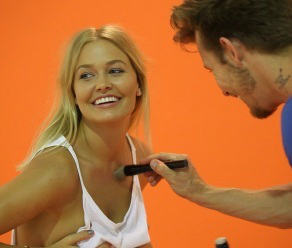
Some groundbreaking programming came to Channel 10 Tuesday night. I say groundbreaking with tongue firmly in cheek. The premiere of
Being Lara Bingle. For those of you reading outside of Australia, Lara Bingle is a 20 something model, beautiful, a bit - errr - naive -and most famous for her relationship with Australian cricketer Michael Clarke. She gets photographed a lot, and seems to get caught out in the nude a lot. She is famous for being famous.
The show is a fly on the wall look at Lara and how she and her (now former) manager slash bestie Hermione are working on "Brand Bingle" ... to improve public perception of her I think.
The show didn't win me over. Truthfully I found it boring.
I commented "God this Lara Bingle show doesn't take much brain power to watch. It's all sideboob and teeth whitener."
That was my impression of it. I thought about how scripted it was. Oh and that perhaps Lara flirts with fame - wanting the attention and then hating it when it gets too much - The Age writes about the contradiction Lara seems to have with privacy
here.
There were equal numbers of fans hating on her and cheering her on through Twitter. While I believe she is ballsy putting herself on show on
Being Lara Bingle, especially with the onslaught of criticism she is going to receive, I don't see her as courageous. Courageous is fighting for a cause or overcoming an illness or adversity. Let's face it - she's a privileged woman being paid to make this TV show and wear beautiful clothes.I found this an interesting angle taken by
Molks TV talk:
"The biggest difficulty surrounding comment of the entire show (and there is plenty, and most of it is unprintable – check the #BeingLaraBingle Twitter stream while you if you should choose to) is that criticism of the show is being misinterpreted as criticism of Lara herself – which is near impossible to separate as it’s not called “Being A Model In Modern Sydney” or “Being A Stupid Head Featuring A Bunch Of Different People Making Bad Decisions”. By having her name in the title and the focus of the show on her in a distinct reality genre means the ‘Lara the character in BLB’ and ‘Lara the actual person’ are going to be judged as one and the same, and from what is portrayed on the screen it’s not going to be flattering."
As I watched the show - and decided that this would be the first and last time I do - I got thinking about how Lara's choice to be a reality TV star, and occupation as a model and dare I say it - socialite - is a lot like being a blogger. I thought about it in the context of my thesis studies. This is where I see the similarities, in the context of such a reality TV show.
Note: when I write our and us when referring to bloggers, I mean me too. I'm ok to cop this observation of mine. I also think the blogs I read and enjoy are poles apart from the content of Lara's show. And I also think, on reflection as a blogger, some of the activities I am about to list are done subconsciously and without intention. It was only when the theories were put in front of me and I came to analyse them and my blog, and my behaviour as a blogger for my thesis, that I had the ah-ha moment. I do see this behaviour in varying degrees across the blogosphere.
Lara and bloggers use the media (reality TV and blogs) to define ourselves and persuade others to feel something about us. Cadle (in Bell, 2007) states:
"A blogger consciously uses visual rhetoric to persuade others and to define self."
On reflecting on why I blog, I considered that I want people to like me through my blog. I want to win others over. Other bloggers may want to persuade their audience to dislike them through writing controversial content and being mean spirited. My blog has also most certainly defined my sense of self - my whole thesis was on the way my blog has helped shape my identit. It has also helped define my self worth and purpose of raising awareness about Ichthyosis and the challenges of living with a visibly different appearance. Lara has used this show to persuade others she is not like the media portrays her. I heard alarm speak on Nova saying her show was a way of telling her story on her own terms (presumably with some savvy editing). Hell, I wrote a
whole blog post about how good it is to have a blog to tell my story about my illness on my own terms. I get your aim, Lara.
There is editing to project the best, and worst of our lives to draw sympathy, empathy and support from our audience.
In
Online Diaries: Reflection on trust, privacy and exhibtion(2008), Paul De Laat writes:
"There is a need to get to know others, to develop a community of sympathisers. Otherwise there would be no point in publishing one's diary in the open."
As mentioned above,
Being Lara Bingle's aim (from Lara's perspective) is to garner some public awareness and sympathy for her life. I am not entirely sure about why the public needs to be made aware of Lara's life when there are so many bigger issues to be made aware of, but that's profit for you. I also think that from the criticism she and the show is receiving, and the blatant contradiction of this reality TV show and then complaining she has no privacy. As someone told me, if I don't like the show, switch it off. If she doesn't like the attention she's receiving, switch those cameras - that she has agreed to be filmed by - off. I digress. Bloggers also blog for sympathy. I'm not writing this is a negative way. When I blog I want my audience to
feel something. When I have moved them and made them think, I know I've done a good job. I don't necessarily want them to feel pity for me, but I do find comfort in knowing that I have support from my audience when things are difficult, and also praise from them when things are going well. I like that - I am very grateful for it. And I am sure other bloggers are too. Blogging creates a support network. And as we have seen on reality TV, even in Lara's case, viewers develop a liking of certain characters or contestants.
Lara and bloggers put our lives on show and invite an audience in. We put out our most intimate thoughts (in Lara's case, the media takes pretty imprimatur pictures of her - consented and non consented).
Paul De Laat focuses on a concept called “extimacy” - that bloggers “entrust the intimacies of their daily lives to the world”. As De Laat writes, bloggers have a one-to-many relationship with their readers, rather than a one-on-one relationship. Through writing a blog, the blogger invites readers into their lives – a concept known as “empowered exhibitionism”. This means the world is often privy to a blogger's most personal thoughts.
Bloggers can choose how much we want to share. Extimacy is a choice, and knowing that I am mostly in control of how my story is told is empowering. Sometimes we overshare. In a celebrity's case, it's harder to control how much of the self is shared with the world. Sharing ourselves with the world can give the expectation of being easily accessible by an audience too. For me it is a privilege to have people read my blog and contact me to give me praise or share their stories. Some of the things my readers have shared with me have been amazing. But I'll be honest in saying that sometimes the accessibility can get too much.
Lara and bloggers open ourselves up for comment and criticism.
Criticism is often not fair and unwarranted. It can be harsh. It can be downright mean. It is damaging,
as I wrote last week. However, by putting ourselves out there means that everyone's going to have an opinion and their points of view may differ to ours. While we shouldn't expect or tolerate criticism, it's bound to happen, especially from those with a high profile.
Lara and bloggers are self promoters.
The very essence of blogging and reality TV is self promotion. As a blogger, I promote myself in my blog content, and promote myself on social media by sharing my posts and engaging with others. It's done quite knowingly. I don't think there's anything wrong with self promotion but I also think that most bloggers have much more intelligent, purposeful and noteworthy content to offer than this type of TV show.
While Lara really isn't my thing, the love and defence I saw that some people on Twitter had for her reminded me of this quote (I used it in my thesis):
Cadle (2005 in Bell 2007, p 103) states “the beauty of a personal weblog is that it can act as a repository for the shifting conceptions of self so necessary for growth...it can also through its concentration on introspection, reflection and support from other young women through the comments feature, create the sort of 'women helping women' environment...” .
Perhaps
Being Lara Bingle will act like a blog does for bloggers. Maybe she will reflect and mature upon watching her show back, and maybe that 'women helping women' thing that's happening in her favour will help her grow too.
I am not saying reality TV is bad. Not everything has to be intellectually stimulating or purposeful. But it's just not an interest of mine. I know it has its place in the world. And I truly thank Lara Bingle for making me think about extimacy so much, and apply it to an actual situation.